This is a short post about Humphrey Blechynden of Rye in Sussex who died in 1563. Humphrey’s will is short and perhaps hastily written and other than a reference to his wife and stepson mentions no other family members so it is hard to be certain where he sits in the family tree. A transcription of Humphrey’s will can be found in here: 16th & 17th Century: Last Wills and Testaments. We can make some educated guesses on Humphrey’s ancestry based on the assumption that he is of a similar age to his wife Elizabeth who he marries in about 1556/7 after the death of her husband Thomas Byrchett of Rye in 1556.
What do we know about Elizabeth and Thomas Byrchett?
We know that Thomas Byrchett was born by 1497 because of his fathers will and, because Thomas was a jurat and Mayor of Rye, there is information on him and his family in the records including here: https://www.historyofparliamentonline.org/volume/1509-1558/member/birchet-thomas-1497-1556#footnote2_fs5igcd
The 1619 Visitation of Kent also sets out some of the Byrchett line and although it doesn’t name Elizabeth it does say that Thomas Byrchett married the daughter and heir of “Young”, so we can perhaps assume that Elizabeth (nee Young) was a wealthy widow when Humphrey Blechyden married her.

I think Elizabeth was probably born by 1510 and married in the early 1530s and records suggest they have at least six children together: four boys (Thomas, John, Peter and Joseph) and two girls (Joan and Agnes), some of whom are adults by the time that Humphrey and Elizabeth marry. We know the baptism dates of some of Elizabeth and Thomas’ children: John, 18 Sept 1541 and buried 4 Oct 1556; Joan, baptised 13 March 1543; Peter, baptised 6 Jun 1547 and Joseph, 28 Oct 1549. We know from later information that Peter wasn’t the oldest of the three surviving sons but is described as the “middle” son which would make sense after John’s death in 1556 and further that son Thomas was the eldest. I have not been able to track down Thomas’ baptism from the 1530s or that of his sister Agnes but we can safely assume that he was born in the 1530s.
Who is this Humphrey Blechynden?
Looking at the Blechynden family tree there are two possible candidates for this Humphrey – either the son of William Blechynden and his second wife Margaret Fox (William Blechynden of Mersham, d 1510) who was born c 1504 or, the son of James Blechynden and Ursula Whetenhall (and therefore the Grandson of William Blechynden and his first wife Agnes Godfrey) who was born probably in the 1520s. Unfortunately records aren’t always available or clear when looking this far back but we can draw conclusions from looking at the records of wills or other dated papers.
On balance, I tend to think that Humphrey is the son of William and Margaret Fox for no other reason than he is more likely to be of a similar age to Elizabeth than the Humphrey that is born 20 or so years later. This Humphrey is the younger brother of John who marries into the influential Crisp family (see: Tudor Crispes, Crayfords and Blechendens) and the half brother of James who marries Ursula Whetenhall. The Blechyndens at this time were on the rise, had land and property and were making some very fortuitous connections. For Elizabeth, widowed with six children, some of who were still not of age, this would have been a good match.
Of course, there could be a third and completely different Humphrey Blechynden that I haven’t so far found in the records but there is one interesting small clue at the end of the will of James Blechynden which states that it is written “in the precense of Michael Hawkes of Rye“. This does illustrate that there are strong links between the Blechynden’s of Kent and a family in Rye.
But why is it worth writing about Humphrey given uncertain parentage and a short will with no named descendents? It is because of his marriage to Elizabeth and the family feud that followed Thomas Byrchett’s death.
Blechenden v Byrchett: The family feud
The Byrchett family (Burchett/Birchett) was one of the most prominent merchant dynasties in 16th-century Rye, active in shipping, local government, and the timber trade. Thomas Byrchett leaned towards Protestantism (as did the Blechyndens), was accused of heresy in 1537 and admonished by the Marian government in 1554 but nevertheless remained influential in Rye. When he died his Will names Elizabeth as the primary beneficiary and one of the executors – she receives a lifetime interest (“duringe her Naturall life”) in a property in Iden parish, occupied by John Master. She receives the house and garden where they currently live. She also receives the profits and income from another property located at the Strand in Rye, occupied by John Colbrand, provided she pays the property’s taxes and ground rent (“lordes Rente”). And the executors are also instructed to finish building projects Thomas started on West Street and next to his house on Tower Street in Rye. Thomas Byrchett sounds like a 16th century property magnate! All these streets still exist in Rye which was in those days a bustling harbour town.
This makes Elizabeth an attractive widow and Humphrey Blechynden quickly makes a move. Humphrey, with his family connections is also an attractive proposition and, shortly after Thomas Byrchett is buried on 30 October 1556, Elizabeth and Humphrey are married probably later in 1556 but perhaps early in 1557. The executors of Thomas Byrchett’s extensive last will and testament were Elizabeth his widow and his son Thomas and we can see that there were issues immediately with this because the Will was proved twice, by Elizabeth on 10 November 1556 and by eldest son Thomas almost a year later on 21 October 1557.
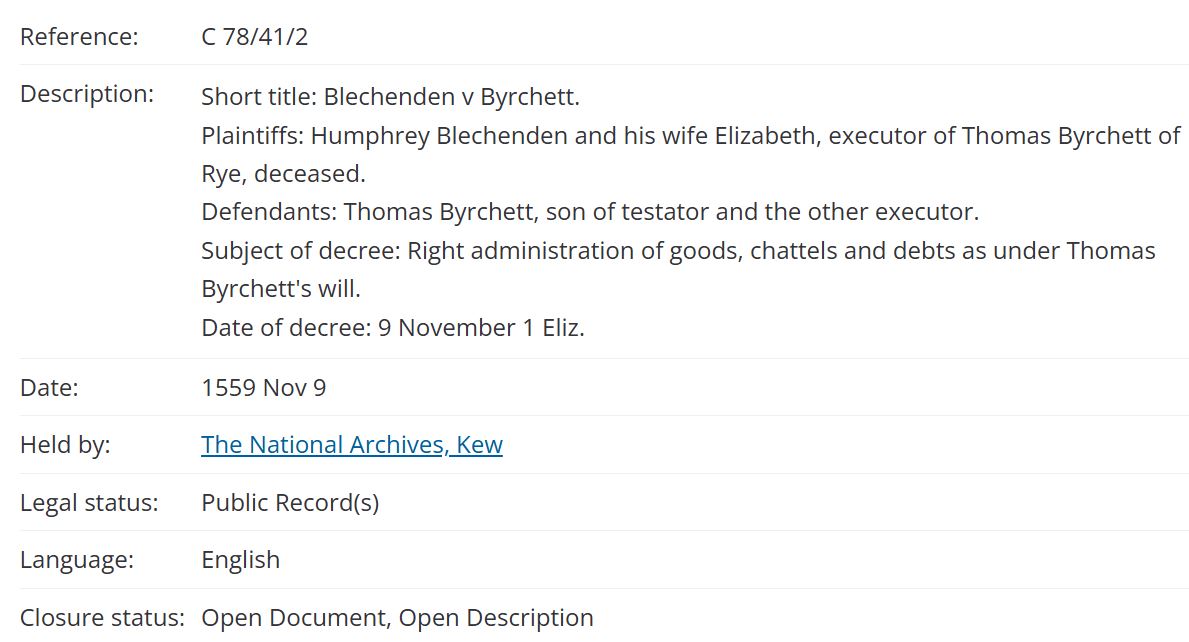
The following extracts from the National Archives show that Elizabeth’s sons were not at all happy with the Will and sought to challenge it. It shows that the legal action started in 1556 so very quickly after Thomas’s death. Not only did the three sons claim about properties in Pleyden but also those in Rye. Humphrey and Elizabeth tried to get the claim dismissed on insuffient grounds to proceed but this was overruled by the court and the case proceeded. I imagine the speed with which their mother remarried added to the concerns of the brothers that they may not inherit some of their father’s estate.
There was also a counter claim by Humphrey and Elizabeth after eldest son Thomas Byrchett took matters into his own hands and, together with a Thomas Neve, tried to take possession of one of the properties at Rye.
The dispute was brought before the Court of Chancery and lasted approximately three years to resolve. The legal standoff reached a definitive resolution on 9 November 1559 (the first year of the reign of Queen Elizabeth I), when the Court of Chancery issued a formal final decree in the case cataloged as Blechenden v. Byrchett and is one of the first decrees recorded under the reign of Elizabeth I.
Because the suit reached a C78 Decree Roll, a formal, binding final judgment or administrative order was issued by the Lord Chancellor. This means the court did not simply dismiss the case; it stepped in to dictate the exact parameters for the “right administration” and division of the deceased’s physical goods, personal chattels, and outstanding debts.

The Court of Chancery operated as a court of equity, designed to balance strict common law or local customs with fairness. The final decree established a highly structured compromise that partitioned the estate between Elizabeth and Humphrey and eldest son Thomas Byrchett as the primary heir. The court recognized both parties as legitimate executors with Humphrey Blechenden and Elizabeth retaining the right to administer the specific goods and chattels bequeathed directly to Elizabeth in the will. Eldest son Thomas Byrchett was confirmed in his independent authority to execute the rest of the estate, protecting his long-term rights as the primary male heir. The bitterest point of contention was the uncompleted construction projects on West Street and Tower Street in Rye and this was strictly regulated to allow Elizabeth (and by extension, Humphrey) to retain her legal right to possess and collect all rental “issues and profits” from the completed buildings for the duration of her natural life, and son Thomas was permitted to oversee the completion of the new buildings to ensure they were constructed to a high standard, preserving his eventual patrimony.
The outcome seems like a fair enough result to me and would have ensured that Elizabeth and Humphrey had a comfortable life in Rye after the three years of legal wrangling with their sons/stepsons. Sadly, Humphrey died only some four years later in 1563. As mentioned earlier his last will is quite short and appears to be hastily written, and he is “sycke in body”. A transcribed copy of it is here: 16th & 17th Century: Last Wills and Testaments. In it he gives a small sum to “poore people” and some to each of his servants with everything else to Elizabeth who is his “sole executrix”. However, there is an unexpected twist at the end of the Will as, not withstanding the years of bitter legal wrangling, Elizabeth’s eldest son Thomas is one of the witnesses which would suggest that the family feud was at an end.
I find this Court Case and particularly the instruction to Thomas Byrchett to complete the new buildings on West Street and Tower Street to a high standard to be particularly noteworthy and I hope that Humphrey supported him in this once the case was resolved. The town of Rye today is no longer the harbour it once was, but it is a lovely place to visit with cobbled streets and Tudor framed buildings in abundance. I took the following images of West Street when I visited this week. The impressive Thomas House on West Street predates I think the building work that the Blechenden and Byrchetts may have done but you can imagine that their houses would have been similar in style. L.A. Vidler in his book A New History of Rye, published 1934, records that some houses at the foot of West Street had become slums by the time of Victorian Britain, deemed beyond repair and pulled down in 1895. So perhaps the buildings which had to be completed to a high standard only lasted some 300 years but perhaps not. Either way West Street remains in essence as it was in Humphreys time.


Elizabeth’s death and a sad ending
I have not found a will for Elizabeth but, in a letter from Roger Manwood to the Mayor and Jurats of Rye dated 11 November 1573, it refers to her death and this is in the context of her middle son, Peter, being charged with murder! (see https://www.historyofparliamentonline.org/volume/1509-1558/member/manwood-roger-ii-1532-92 for more on Roger Manwood). We know that Thomas Byrchett was a protestant and was admonished by the Marian government but son Peter became a fanatical Putitan whilst at Middle Temple and, on 11 October 1573, he ambushed and stabbed the celebrated English naval commander Sir John Hawkins (Sir Francis Drake’s cousin!) while Hawkins was riding down the Strand in London. Happily Hawkins survived given that he wasn’t Peter Byrchett’s target – this was a case of mistaken identity as Byrchett mistook him for Sir Christopher Hatton, whom he viewed as an enemy to the devout Puritan cause. Sir Christopher Hatton was a personal favourite of the Queen and later bacame her Lord Chancellor. Peter Byrchett was immediately arrested and thrown into the Lollards’ Tower at Old St. Paul’s Cathedral. Originally built to store bells, it served as an holding space for suspected heretics.
Peter Byrchett may well have been hanged for heresy and his attack on Sir John Hawkins but he recanted. However, whilst imprisoned he attacked his prison keeper, John Longworth, and killed him. Queen Elizabeth was so enraged by the actions of Peter Byrchett that she demanded he be put to death immediately, but her councillors persuaded her to follow established process and Peter Byrchett was tried and convicted of murder. On 12 November 1573 he was taken to the Strand near to the place he had attacked Hawkings, his right hand was cut off (the one he had used to attack Hawkins) whilst he was still alive and he was then publicly hanged.
Peter Byrchett’s actions must have had consequences for the family. It would appear that his mother Elizabeth had died by this time and so her estate would have been passed down to her remaining sons and through eldest son Thomas. However, Peter’s conviction of murder meant that his property fell subject to the process of “catalla felonum” which refers to the goods and personal property of a convicted felon that were forfeited to the Crown or a local lord.
Roger Manwood’s letter and sound legal advice (dated the day before the execution of Peter Byrchett) to the Mayor and Jurats of Rye presses them to secure the property and goods that were so hard fought for in court and to take a proper inventory to ensure that the two remaining sons, Thomas and Joseph, did not “perchance intermeddyll with any of the sayd goodes as belongs to hym, wheras in truthe they dyd not belong to hym” and help to “shew what ryght to any parte of the sayd goodes can be claymed”. This shows that some of the land and property that was the subject of the court case would have passed to Peter but was now the property of the Crown. But exactly what that was was still to be decided.
The compromise outcome to the family feud imposed by the Lord Chancellor and the eventual reconciliation of the family by the time of Humphrey Blechynden’s death was seemingly all for nought. The religious fanaticism of Peter Byrchett, whose muderous intent so enraged Queen Elizabeth, had once more raised a question mark over the lawful ownership of various land and properties in and around Rye. I hope that this time they resolved it much more quickly.