Today’s post pulls together some threads about Mary Blechynden who was born in London, married William Bache in the early 1700s and died in 1777. It was meant to be a short post but there is actually quite a lot to cover. Mary is worth a mention because of her children who emigrate to America, are involved in the emergence of America as an independent nation and closely connected by marriage to the “Founding Father” Benjamin Franklin, who also corresponds and visits with Mary whilst living in England.
It would seem that the house that Mary, and certainly some of her daughters, lived in, in Preston, is no longer there but an inaccurately phrased blue plaque marks the spot where Benjamin Franklin visited with Mary (Blechynden) Bache – the site which is now a Cafe Nero! I’m not sure it is true to say that he “lived briefly” in a house on that site but perhaps a Benjamin Franklin expert can demonstrate otherwise.

Mary’s Parents?
It isn’t immediately clear who Mary’s parents are but I believe them to be Theophylact Blechynden and Elizabeth Garland who were married in 1700 (date of their marriage license is 31 December 1700). I have seen one suggestion that she may have been the daughter of Samuel Blechynden of Chester, the collector of salt duties at Middlewich, but I can’t see any suggestion that Samuel married or had children either in the parish records, in his will or the wills of his nearest family and the epitaph for him at St Michael and All Angels in Middlewich, Cheshire, makes no mention of any wife or children.
We do, however, have information on the children of Theophylact and Elizabeth who were baptised at St Andrew’s in Holborn, London including Thomas in 1702 (20 May), Mary in 1703 (30 June), Richard in 1704 (29 August) and Theophilact in 1705 (11 November). The extract from Mary’s baptism record below shows that Theophylact and Elizabeth were living at Hatton Garden in central London at the time – an upcoming and fashionable part of London and now famed as the epicentre of London’s jewellery trade.

One of the reasons why I have concluded that this Mary is the daughter of Theophylact Blechynden and Elizabeth Garland is because Mary’s son, also Theophylact, names his eldest daughter Elizabeth Garland Bache and it wasn’t unusual to have a mother’s or grandmother’s maiden name passed down the family line in some way. It may be that he names his daughter after another Elizabeth Garland, that I will mention later in this post, but that still suggests to me a family relationship.
Mary’s marriage to William Bache
The marriage record for Mary (Blotchynden) and William (Bach) states they married on the 28 January 1720 in, surprisingly, Worcestershire. As the daughter of Theophylact and Elizabeth, Mary can only have been, at most, 17 years old at this time. I don’t imagine there were many (any) other Mary Blechynden and William Bache marriages in the early 1700’s so this is highly likely to be the right one.

It has been hard to trace William and Mary and their children in part because they seem to move around quite a lot which is unusual – they are married in Worcestershire (the parish records are not specific about where), daughter Lydia’s baptism in 1731 suggests they lived in the City of London, other baptisms show they moved to Giggleswick near Settle in North Yorkshire and the family then moved to Preston in Lancashire, some 35 miles from Settle in Yorkshire where at least one child – Anna Maria Bache – was born and baptised. Perhaps William’s job as a Collector of Excise required him to move for work? We know from what I shall call the “Franklin letters” that Mary and four of her daughters remained in Preston and that she remained there until her death in 1777.
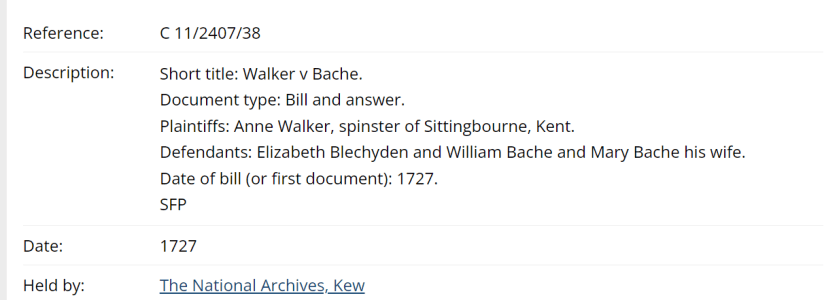
I have found another reference to William and Mary where they were the defendents in a legal case involving Mary’s mother Elizabeth and an Anne Walker of Sittingbourne in Kent but no other evidence to suggest that William and Mary lived in Kent after their marriage.
It has also been difficult to trace William and Mary and their children because of the Bache surname which is, I understand, pronounced Baitch or Beech, and this has led to many different versions of the name across the records. Even in Mary’s burial record she is “Mrs Mary Beech” and William’s burial record is “William Beach Esq Collector of Excise”.
William and Mary Bache’s Children
William Bache died in 1746, 26 years after their marriage and was buried on 14 September 1746 at the Church of St John, Preston, in Lancashire. This left Mary to bring up their children and it has been suggested that they had up to 20 children which I have been unable to verify. For example I have found one suggestion here http://famousamericans.net/theophylactbache/ that son Richard was “the eighteenth child” which would be quite something given William and Mary weren’t married until 1720 and Richard was born in 1737. I also haven’t found yet, with any certainty, children born before 1731 which you would expect to see. I do wonder if the alleged large number of children is because Mary was a second wife and the 18 or 20 children include children from William’s first marriage (but more on this later…). A list of the children/step-children that I have been able to identify is further down in this post.
I have found references to William and Mary’s children across baptism records, various wills and in the “Franklin letters” at Founders Online. As well as the letters from Mary there are letters from sons Richard and Theophylact and the letters mention her daughters Martha, Lydia and Anna Maria, the youngest child. Anna Maria (also known as “Nancy”), is mentioned in a letter from James Theobald to Benjamin Franklin which passes on the news of Mary (Blechynden) Bache’s death on 27 October 1777. James Theobald is the husband of Jane Harriet Blechynden, Mary Bache’s neice through Mary’s brother Thomas Blechynden.
The editors of Founders Online state that, in 1772, Richard Bache had four sisters living: Martha, Lydia and Anna Maria but have been unable to trace the fourth. However, I think the fourth sister is another Mary Bache as evidenced in Lydia’s will, dated 1803, where she refers to her “three dear sisters Mary Bache, Martha Bache and Anna Maria Bache” to whom she leaves her personal items and makes joint executers. No other family members are mentioned. It is possible that this Mary Bache is a step daughter rather than a natural daughter of Mary which might explain why she is not mentioned in the 1765 will of Florence Poyntz or in the 1773 will of Elizabeth Richard. It is also possible that this Mary is perhaps a daughter-in-law but given the references in the Franklin letters to four sisters living with their mother Mary (Blechynden) Bache I am lean towards this Mary being a daughter or step-daughter.
It also looks as if Mary had another daughter, Elizabeth, as, in the 1765 will of Florence Blechynden (Fulton/Poyntz) she bequeathes “One Hundred and Forty Pounds current money of Jamaica each” to “my Sister in Law Mary Beach of Lancashire in the Kingdom of Great Britain widow and to her daughter Elizabeth of the same place spinster“. Florence Poyntz (nee Fulton) married Theophylact Blechynden, the younger brother of Mary, in Jamaica in 1731. It seems likely that “Flowrence Bache” who was born in 1739 in Giggleswick is named after Florence Blechynden (Fulton/Poyntz) as it isn’t a family name and the reference to Mary in Florence’s will suggests they were close. The lack of any further references to Elizabeth Bache in the letters, or in the surviving wills, makes me conclude that she probably died some time between 1765 and 1771, but I have not found an obvious death record.
Mary’s sons: Theophylact and richard
William and Mary’s two sons Theophylact and Richard both move to America at a pivotal point in that country’s history. I have set out a little on each of them below but information is available online for those who want to dig a little deeper.
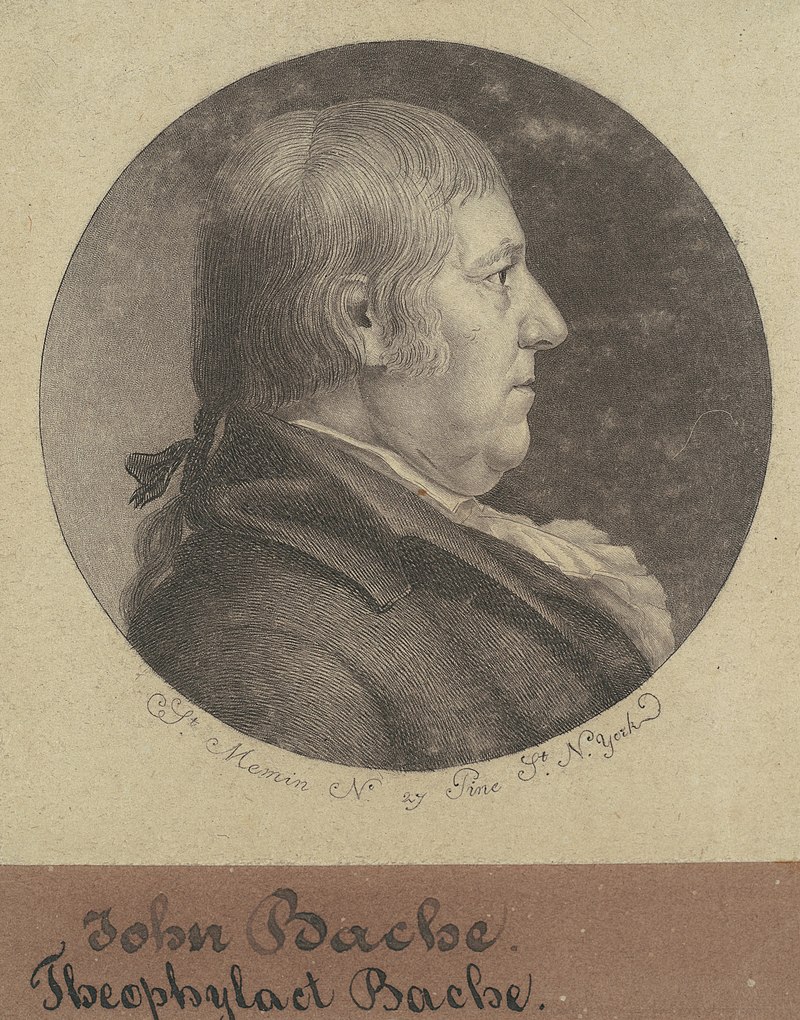
Theophylact, named after his grandfather, is born in 1734/35 in Giggleswick in North Yorkshire but in 1751, at the age of just 16, he left home and moved to New York to try his hand at business. He arrived in New York on 17 September 1751 and took charge of the business of Paul Richard who was a successful merchant and who had been the 37th Mayor of New York between 1735-39.
Working for Paul Richard was, in effect, entering a family business as Paul Richard’s wife was a relative of Mary and in some documents referred to as Theophylact’s aunt. Mrs Paul Richard was also an Elizabeth Garland, the same name as Theophylact’s grandmother! In her will dated 3 March 1773, she refers to Mary as her “cousin”:
To cousin, Mary Bache, of Preston, County of Lancashire, England (widow of William Bache, dec’d), £500. In case she predeceases testatrix, £400 of the £500 as follows: Lydia Bache, Martha Bache and Anna Maria Bache (daughters of said Mary Bache) each £100; remainder to residue.
Documents Relating to the Colonial History of the State of New Jersey, Calendar of New Jersey Wills, Volume VIII: 1791-1795, By Elmer T. Hutchinson
A portrait of this Elizabeth Garland, i.e. Mrs Elizabeth Richard (1700-1774) can be found here: https://emuseum.mfah.org/objects/4957/portrait-of-mrs-paul-richard-elizabeth-garland-17001774 .
When Elizabeth Richard died she left this portrait of herself to her “dearly beloved kinsman” and executer, Theophylact who also inherited the bulk of her estate. After Paul Richard died in 1756 Theophylact became the owner of merchant vessels, and engaged in privateering i.e. legalized piracy to permit merchant vessels to disrupt and take possession of goods from other vessels. Theophylact was clearly successful in this and other endeavours and in 1777 he was chosen as the fifth president of the New York Chambers of Commerce.
In 1760 Theophylact married Ann Dorothy Barclay, daughter of Andrew and Helen (Roosevelt) Barclay. They had 14 children, ten of whom survived infancy.
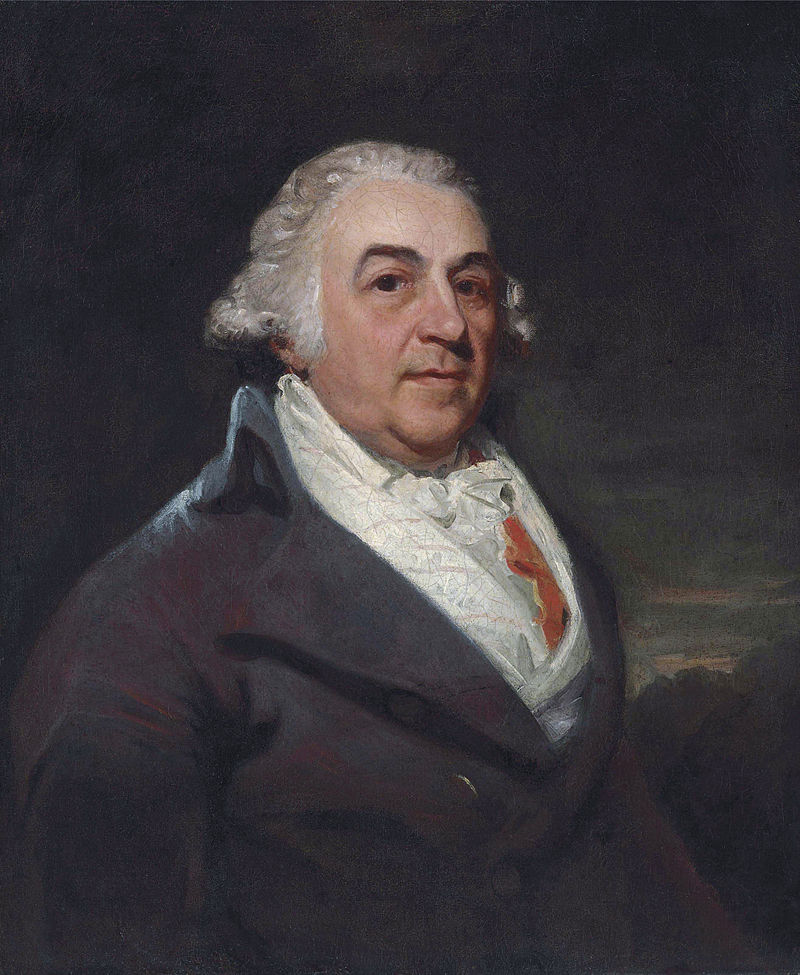
Richard, like his brother Theophylact, was born in Giggleswick in North Yorkshire and moved to America to try his hand in business but with varying degrees of success. He met and married Sarah “Sally” Franklin, the only daughter of Benjamin Franklin. Initially concerned that Richard was only marrying Sarah for her money, over time and with the arrival of grand children, Benjamin Franklin accepted the marriage and his new in-laws.
The first time Richard met with his father-in-law was at Preston where they both stayed with Mary for two days before travelling down to London together. In 1775, Benjamin Franklin became the first Postmaster General of what is now the United States Postal Service and was succeeded in that role by his son-in-law Richard in 1776. Richard and Sarah were the main beneficiaries of Benjamin Franklin’s will, they had eight children together and any decendents of Benjamin Franklin today are through this marriage.
a previous marriage?
I suggested earlier that Mary was, perhaps, William Bache’s second wife given the allegedly large number of children that they had in their 26 years together. One piece of evidence for this is the marriage of Humphrey Bache who, when he marries Ann (“Nancy”) Cowburn in 1750/01, is described as being aged 33 years and upwards which would mean he was born in c 1717. There is a baptism record for a Humphrey Bache, son of William and Elizabeth Bache, baptised 26 February 1717 in Saint Helen’s Worcester.
Humphrey is a Supervisor of Excise, like his father William, and one of the witnesses to the marriage bond is Lydia Bache and when he dies is 1768, after his wife Ann, it is Mary Bache (“Spinster” so probably his sister and the same Mary I mentioned above) who is made joint administrator of Humphrey’s children: William, Charles and Lucretia who are all minors at the time. Lucretia marries James Hodgson and when their daughter Cordelia Jane Hodgson dies at the age of 78 her obituary refers back to the family connection to Benjamin Franklin:
His father married Miss Lucreatia Bache, the daughter of Mr. Humphrey Bache, supervisor of Excise, and of Nancy, his wife, daughter of General Cowburn, at one time Governor of Edinburgh Castle. Miss Hodgson’s grandmother was related to Dr. Franklin, who lived with her during the latterpart of 1771, on the occasion of his first visit to Preston. ‘Franklin’s only daughter was married to Mr. R. Bache whose children lived in Philadelphia in 1825. During this visit, or the subsequent one of 1775, when he appeared in the character of refugee, Dr. Franklin made an ingenious musical toy for Miss Lucretia Bache, the origin of the harmonica, which, after passing into the possession of the late Mr. Taylor, of Moss Cottage, Preston, was lost at a bazaar for which it was borrowed.
All of the above indicates to me that William was married before he married Mary to someone called Elizabeth. They had at least one child together, Humphrey, who was born in Worcester, where, following his wife’s death, William remarried to Mary Blechynden who we know he married in 1720 somewhere in Worcestershire. It is probable then that Mary, as well as having her own children with William, also became a step-mother at the age of just 17 to Humphrey and perhaps other infants as well.
Details of William and Mary’s children/step-children found to date include:
- Humphrey Bache, supervisor of excise, marries Ann Cowburn of Preston 1750/01. Lydia Bache is a witness to the marriage bond (although marriage bond suggests he may have been born in 1717).
- Mary Bache, mentioned in Lydia’s will dated 1803 and Anna Maria’s of 1810. Also joint administrator of Humphrey’s children who were minors when he died in 1768. Perhaps a daughter of William and his first wife Elizabeth.
- Lydia Bache born 19 March 1731 and baptised 16 April 1731, St Mary Woolnoth, London, England; parents William and Mary Bache. Also referenced in a letter from Richard Bache dated 16 May 1772. Named in the will of Elizabeth Richard dated 1773.
- Martha Bache, born c 1732, buried 3 November 1819 St John, Preston, Lancashire aged 87. Also mentioned in a letter from her mother to Benjamin Franklin dated 5 February 1772, in Elizabeth Richard’s will dated 1773; in Lydia’s will dated 1803 and Anna Maria’s will dated 1810.
- Theophylact Bache baptised 3 February 1734, Giggleswick, North Yorkshire, England; father Jno. Bache. Moved to Philadelphia and married Ann Dorothea Barclay (a daughter of Andrew Barclay and Helena (née Roosevelt) Barclay).
- Richard Bache baptised 3 October 1737, Giggleswick, North Yorkshire, England; father “Beache”. Married Sarah Franklin the only daughter of Benjamin Franklin in 1767. He served as Postmaster-General of the American Post Office.
- Flowrance Bache baptised 29 June 1739, Giggleswick, North Yorkshire, England; father Bache. Possibly the “Jane Florence Bache” buried at St John, Preston, Lancashire on 10 Aug 1763.
- Elizabeth Bache mentioned in the will of Florence Blechynden, Mary’s sister-in-law, dated 27 April 1765.
- Anna-Maria Bache, born 16 December 1744, baptised 18 Jan 1744/5 St John, Preston, Lancs. died 1810 and left a will. Parents William and Mary Bache, father’s occupation “collector”. Buried 24 April 1810 St John, Preston, Lancashire, aged 64. She is named in Elizabeth Richard’s will dated 1773; also mentioned in a letter from James Theobald to Benjamin Franklin dated 27 October 1777 and in Lydia’s will dated 1803.
A couple of points on the above. Giggleswick is a small village in North Yorkshire about one mile north of Settle where we know Theophylact and Richard spent their childhood so the baptism records match what we know about them and also indicates that Flowrance is a sister despite lack of any further information on her. Secondly, it is puzzling that the baptism record for Theophylact states his parent as “Jno.” and not “Wm.” Given other records refer to his parents as William and Mary I am assuming, for now, that this is a transcription error.
the benjamin Franklin connection
As mentioned already we know from correspondence that has survived that Mary (Blechynden) Bache corresponded with Benjamin Franklin and that he visited with her and four of her daughters, in Preston, in November 1771. It seems to be generally understood that he visited Preston again in 1775 before he returned to America although I have not found surviving correspondence which supports this later date.
Mary refers to Benjamin Franklin as “my dear brother” and this is because Mary’s son Richard Bache married Benjamin Franklin’s only daughter Sarah (Sally) Franklin on 29 October 1767. The excellent Founders Online website https://founders.archives.gov/ has correspondence with the Bache family including three letters from Mary herself as well as numerous letters from Richard. It’s quite exciting to read an actual letter from a member of the Blechynden family and to hear things said in her own “voice”. The following extract is from Mary to Benjamin Franklin after his first visit to Preston in 1771 where she states that she hopes he will visit again:
We are Much please’d at the hopes you give us of injoying your good and agreeable Company again at my house, you likewise Make us happy by Nameing a Longer Stay. I hope Nothing will intervene to prevent us that Much Wish’d for happyness.
I can assure my Dear Brother I am no little happy in having it in my power to style my self your affectionate Sister and humble Servant
Mary Bache
https://founders.archives.gov/documents/Franklin/01-18-02-0166
Dr Franklin quickly followed up his visit to the Bache family by sending them a present – a likeness of himself! Perhaps it was something like the following which was painted by Joseph Siffred Duplessis in 1779. Mary wrote to thank him for the gift:

I receiv’d your kind, and agreeable preasant, which gave us all great pleasure it is so like the original. You cannot imagine with what pleasure we look at it, as we can perceive in it, the likeness of my Son, as well as your Self. My daughter Marther told Mr. Atherton that Doctor Franklin was come, the Next Morning he came down, and ask’t wather the Doctor was up, and when you was produced, it made us all very Merry. You are sume times in the dineinroom, and other times in the parlor, ware we vew it with pleasure. https://founders.archives.gov/documents/Franklin/01-19-02-0042
The following extract is from a letter from Mary’s son Richard Bache to his father-in-law Benjamin Franklin after his first visit to Mary and her daughters. Richard calls his mother Mary “a good Old Woman” and note the very specific reference to “four daughters”:
Dear and Honoured Sir
Since my last I am favored with yours of the 4th [?] 14 and 16 July by the Captain’s Osborne All and Sparks, the first dated at Preston, where I find you have been making happy by your Presence a good Old Woman and her four Daughters.
https://founders.archives.gov/documents/Franklin/01-19-02-0211
There is a further letter from Mary to Benjamin Franklin dated 14 June 1772 where she thanks him for his letter informing her of her son Richard’s safe arrival in Philadelphia and to entreat her “Dear Brother” to visit again in his latest trip north as he was due to be in Leeds at the end of the month:
I heartyly wish you a pleasant Journey, and hope you wont disapoint us, but let us have the happyness of your agreeable Company for Sume time, ware [where] we will do our best indavour to amuse you, and I have a good bed at your Sarvis, and a hearty wellcome to our poor climate [?] the prospects are now delightfull, and I hope you will injoy them. From Dear Brother Your affectionate Sister and humble Servant
Mary Bache
https://founders.archives.gov/documents/Franklin/01-19-02-0121
There is a final letter which speaks to the affection with which Mary was held and it is one from James Theobald to Benjamin Franklin passing on the news of the death of the “very best of Mothers” in 1777:
Dear Sir.
I take the Liberty of acquainting You….That on the 27 past I Recieved a Letter from Miss Lydia B. of Preston Acquainting Us That on the 24 past She and her afflicted Sisters had the Misfortune to loose the very best of Mothers. She begged I would acquaint you if possible with this melancholy Event and to intreat you would break it to our Worthy and Esteemed Freind R. B. We have broke it to Her Dear Sister Anna Maria B in the tenderest manner we Could, she is at present inconsolable, but We hope Her Good Sence, and Time will alleviate her present Distress.
https://founders.archives.gov/documents/Franklin/01-25-02-0094
Memorial
The Blechynden name continued briefly in the Bache family when, in 1808, a grandchild of Richard Bache and Sally Franklin was named Mary Blechynden Bache, no doubt for the great grandmother she sadly never knew.
This Mary Blechynden Bache would continue the family’s connections with the political class in America by marrying Robert John Walker a lawyer who would serve in the United States Senate, was appointed Secretary of the Treasury and briefly served as Governor of Kansas. A memorial for Mary Blechynden Bache and Robert John Walker can be found here: https://www.findagrave.com/memorial/48208203/mary-blechynden-walker but sadly I have found no actual memorial for Mary Bache or her husband William.
But we do have her letters and from those of her family which, although they are not many, still speak to her character and the high regard in which she was held as the “very best of Mothers”. And we know where she lived in Preston – even if the site is now a coffee shop. I think she would approve.





 My Family History Notes