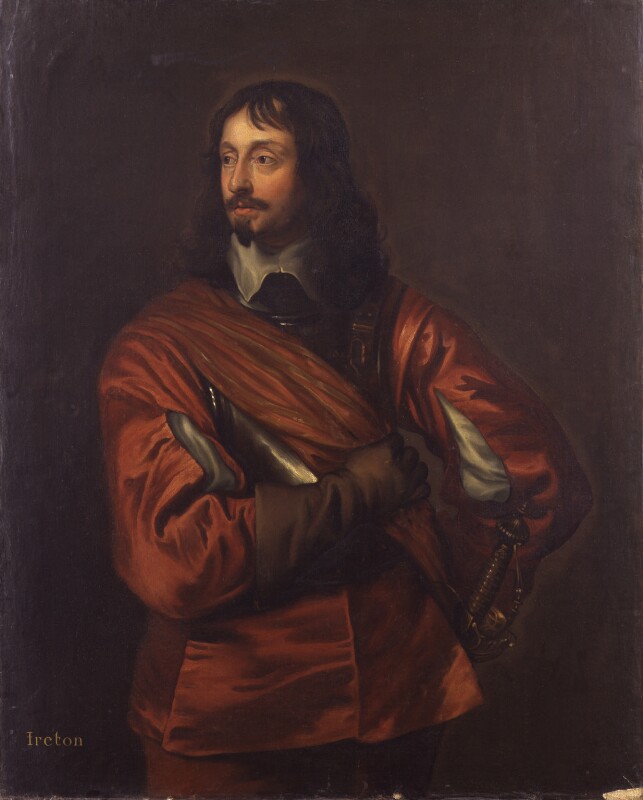
Peter Wentworth MP, died 10 November 1596, Tower of London

Peter Wentworth MP died in the Tower of London on his third stay there. His wife Elizabeth Walsingham, also died in the Tower a few short months before hand. She had been given permission to stay with her husband in the Tower and he described her as “my cheifest comfort in this life, even the best wife that ever poor gentleman enjoyed”. Wentworth even refused to be released from the Tower because it would be too much to be sent home to Lillingstone Lovell with memories of his wife there. He died in the Tower on 10 November 1596.

I am always a little surprised that the Wentworths died in the Tower, after all Elizabeth was the sister of Sir Francis Walsingham, Elizabeth I’s “spymaster”. Did family count for nothing? But Sir Francis died in 1590 so could pull no strings and Peter Wentworth was his own worst enemy. He knew what would land him in trouble but carried on anyway. And I am full of admiration for him because of that.

Peter Wentworth was a thoughtful man, deliberate in what he said, and not one to pull any punches. In Parliament he raised the question of the Royal Succession, openly criticised the Queen and advocated for freedom of speech in Parliament. These were radical, maybe even treasonous, ideas especially as Elizabeth I had put in place controls over what the Commons could or could not discuss.

I have to admit that before digging around my family history I was not aware of Peter Wentworth or the speeches he made to Parliament and I think he deserves a wider audience, maybe a place in the national curriculum. I have mentioned in an earlier blog his connection to the Boys and Blechenden families so this one will just focus on controversial career in the House of Commons.

House of Commons, 11 November 1566

In 1566 Queen Elizabeth I had been on the throne for eight years and, aged 33, questions about her marriage and succession were rife. On 5 November of that year a delegation of 60 Lords and Commoners met with the Queen to urge her to consider the question of her marriage and the succession which provoked an angry response and on 6 November she sent a message to the Lords and the Commons that they were not to discuss the succession:

her Grace had signified to both Houses, by words of a Prince, that she by Gods Grace would Marry, and would have it therefore believed; and touching limitation for Succession, the perils be so great to her Person, and whereof the hath felt part in her Sisters time, that time will not yet suffer to trèat of it.

On 11 November Peter Wentworth questioned whether the Queen’s command to not discuss the question of her succession was contrary to the liberties and privileges of the House? The matter was debated for some time and the following day the Speaker of the House had to relay a special Command from her Highness that there should not be further talk of that matter in the House. Although the Queen later softened her approach, at least for a time, it is clear that freedom of speech in Parliament was only with Her Majesties Gracious Permission. Peter Wentworth’s questions, written in his hand, regarding the liberties of the House to free speech, have survived and can be seen on the National Archives website:

Whether hyr hyghnes’ commandment, forbyddyng the Lower Howse to speake or treate any more of the succession or of any theyre escewsses in that behalffe, be a breache of the lybertie of the free speache of the howse or not?

Wheter Mr Controller, the vicechamberlaine, and Mr Secretarye pronowncyng in the Howse the sayd commandment in hyr hyghness’ name, are of awthorytye suffycyent to bynde the howse to silence in that behalffe, or to bynde the howse to acknowledge the same to be a direct and sufficient commandment or not?

Yf hr hyghness’ said commandment be no breache of ye lybertie of the howse, or yf the commandment pronownced as afore is sayde be a suffycyent commandment to bynd the howse to take knoledge theroff, then what offence is it for anye of the howse to err in declaryng his opynyon to be otherwys?

https://www.nationalarchives.gov.uk/education/resources/elizabeth-monarchy/peter-wentworths-questions/
House of Commons, 8 February 1576

Between 1572 and 1576 Parliament was prorogued on no less than ten occasions which gave Peter Wentworth time to consider the speech that he would deliver on the first day of the new session on 8 February 1576. This is his speech that is best known amongst parliamentary orations and is credited with being the first ever full statement of the doctrine of freedom of speech in the House of Commons.

Mr. Speaker, I find written in a little volume of words these words in effect: Sweet indeed is the name of Liberty and the thing itself a value beyond all inestimable Treasure. So much the more it behoveth us to take care lest we contenting our selves with the sweetness of the name, lose and forgo the thing, being of the greatest value that can come unto this noble Realm.

He criticised the infringements upon the freedom of speech in previous sessions of Parliament and argued that without it it was just a place of “flattery and dissimulation”. It’s not hard to see why some of his fellow parliamentarians may not have welcomed Wentworth’s words:

I was never of Parliament but the last and the last Session, at both which times I saw the Liberty of free Speech, the which is the only Salve to heal all the Sores of this Common-Wealth, so much and so many ways infringed, and so many abuses offered to this Honourable Council, as hath much grieved me even of very Conscience and love to my Prince and State. 

…that in this House which is termed a place of free Speech, there is nothing so necessary for the preservation of the Prince and State as free Speech, and without it is a scorn and mockery to call it a Parliament House, for in truth it is none, but a very School of Flattery and Dissimulation, and so a fit place to serve the Devil and his Angels in, and not to glorify God and benefit the Common-Wealth.

He carefully spoke about rumours and messages on what the Queen liketh or liketh not and why these did ‘very great hurt’:

Amongst other, Mr Speaker, Two things do great hurt in this place, of the which I do mean to speak: the one is a rumour which runneth about the House and this it is, take heed what you do, the Queens Majesty liketh not such a matter, whosoever prefereth it, she will be offended with him; or the contrary, her Majesty liketh of such a matter, whosoever speaketh against it she will be much offended with him.

The other: sometimes a Message is brought into the House either of Commanding or Inhibiting, very injurious to the freedom of Speech and Consultation, I would to God, Mr Speaker, that these two were Buried in Hell, I mean rumours and Messages; for wicked undoubtedly they are, the reason is, the Devil was the first Author of them, from whom proceedeth nothing but wickedness.

Wentworth, argued that only by speeking freely could they best serve Her Majesty, even if that meant suffering the Queen’s displeasure:

Then I will set down my opinion herein, that is, he that dissembleth to her Majesties peril, is to be counted as an hateful Enemy; for that he giveth unto her Majesty a detestable Judas his Kiss; and he that contrarieth her mind to her Preservation, yea though her Majesty would be much offended with him, is to be adjudged an approved Lover, for faithful are the wounds of a Lover, saith Solomon, but the Kisses of an Enemy are deceitful.

 And he similarly exhorted the Queen to heed the advice of her councillors, with cricicism implied, or, rather ominously, risk the instability of her Kingdom:

And I beseech the same God to endue her Majesty with his Wisdom, whereby she may discern faithful advice from traiterous sugared Speeches, and to send her Majesty a melting yielding heart unto sound Counsel, that Will may not stand for a Reason: and then her Majesty will stand when her Enemies are fallen, for no Estate can stand where the Prince will not be governed by advice.

Unfortunately for Wentworth his arguments for the need for freedom of speech in Parliament led him to a more direct and explicit cricisism of the Queen -although he argued throughout that this was said for her own good as a faithful servant of Her Majesty:

Certain it is Mr. Speaker that none is without fault, no, not our noble Queen … Her Majesty hath committed great faults, yea dangerous faults to herself and the state … It is a dangerous thing in a prince unkindly to entreat and abuse his or her nobility and people as her Majesty did the last Parliament, and it is a dangerous thing in a prince to oppose or bend herself against her Nobility and People … and how could any prince more unkindly entreat, abuse and oppose herself against her nobility and people than her Majesty did the last Parliament? Did she not call it of purpose to prevent traitorous perils to her person and for no ther cause? Did not her Majesty send unto us two bills, willing us to make a choice of that we liked best for her safety and thereof to make a law, promising her Majesty’s royal consent thereto? And did we not first choose the one and her Majesty refused it, yielding no reason, nay yielding great reasons why she ought to have yielded to it? Yet did not we nevertheless receive the other and agreeing to make a law thereof did not her Majesty in the end refuse all our travails? And did not we her Majesty’s faithful nobility and subjects plainly and openly decipher ourselves unto her Majesty and our hateful enemy? And hath not her Majesty left us all to her open revenge? Is this a just recompence in our Christian Queen for our faithful dealings?

…It is a great and special part of our duty and office Mr. Speaker to maintain the freedom of consultation and speech for by this are good laws that do set forth God’s glory and are for the preservation of the prince and state made.

Therefore I say again and again, hate that is evil and cleave to that that is good. And this, loving and faithful hearted, I do wish to be conceived in fear of God, and of love to our prince and state, for we are incorporated into this place to serve God and all England and not to be Time-Servers and Humour Feeders, as Cancers that would pierce the Bone, or as Flatterers that would fain beguile all the World…

I particularly like the last sentence and perhaps all modern Parliamentarians should consider that they are incorporated into this place to serve God and all England and not to be times-servers and humour feeders.

Wentworth drew his speech to a close with the following although it is also suggested that he was interrupted at this point out of a reverend regard of her Majesty’s Honour and and he was stooped from proceeding before he had fully finished his Speech:

Thus I have holden you long with my rude Speech, the which since it tendeth wholly with pure Conscience to seek the advancement of Gods Glory, our Honourable Soveraigns Safety, and to the sure defence of this noble Isle of England, and all by maintaining of the Liberties of this Honourable Councel, the Fountain from whence all these do Spring; my humble and hearty Suit unto you all is, to accept my good will, and that this that I have here spoken out of Conscience and great zeal unto my Prince and State, may not be buried in the Pit of Oblivion, and so no good come thereof.

Peter Wentworth was immediately sequestered for this speech and questioned by members of the Queen’s privvy council in the afternoon of the 8th February. A transcript of the questioning remains and it is interesting to see him invoke parliamentary privilege, although he does not use that term. Parliamentary privilege is enshrined in the Bill of Rights over 100 years later: Article 9 of the Bill of Rights (1689) states “the freedom of speech and debates or proceedings in parliament ought not to be impeached or questioned in any court or place out of Parliament” but in 1576 when Wentworth is asked about certain rumors of the Queens Majesty, he answers:

If your Honours ask me as Councellors to her Majesty, you shall pardon me; I will make you no Answer: I will do no such injury to the place from whence I came; for I am now no private Person, I am a publick, and a Councellor to the whole State in that place where it is lawful for me to speak my mind freely, and not for you as Councellors to call me to account for any thing that I do speak in the House; and therefore if you ask me as Councellors to her Majesty, you shall pardon me, I will make no Answer; but if you ask me as Committees from the House, I will make you the best Answer I can.

During the questioning Wentworth is asked to explain himself and demonstrate the truth of his speech and again and again the committee is forced to agree with him, until at last they just admit he could have phrased it better!:

Commit. Yea but you might have uttered it in better terms…

Despite this Peter Wentworth was committed to the Tower for his “violent and wicked words” on 9 February and “there to remain until such Time as this House should have further Consideration of him”.

House of Commons, 12 March 1576

Fortunately for Peter Wentworth he was not in the Tower of London for too long, as by the Queens special favour he was restored again to his Liberty and place in the House on Monday 12 March that same year. But not before he had to make an admission of his fault on his knees:

Mr Peter Wentworth was brought by the Serjeant at Arms that attended the House, to the Bar within the same, and after some Declaration made unto him by Mr Speaker in the name of the whole House both of his own great fault and offence, and also of her Majesties great and bountiful mercy shewed unto him, and after his humble Submission upon his Knees acknowledging his fault, and craving her Majesties Pardon and Favour, he was received again into the House, and restored to his place to the great contentment of all that were present.

House of Commons, 1 March 1587

In 1587 not only was the question of sucession central to Elizabeth’s reign but she was also grappling with religious turmoil which the Elizabethan Settlement had sought to address. It did not. Peter Wentworth was a puritan and was MP for Northampton, a centre of puritan activity. When in 1587 the Queen surpressed a parliamentary Bill which sought to presbyterianize the Anglican church, Peter Wentworth was ready to argue for the right to debate the matter. He prepared again a series of questions on the matter, including the one below, but the Speaker on reviewing the Articles “pocketted” them up, showed them to Sir Thomas Heneage, and Wentworth was committed straight to the Tower and the questions were not moved at all. It is unclear how long he remained there.

Whether this Council be not a place for any Member of the same here assembled freely and without controllment of any person or danger of Laws, by Bill or speech to utter any of the griefs of this Commonwealth whatsoever touching the service of God, the safety of the Prince and this Noble Realm.

One of Wentworth’s questions that were never put before the House of Commons. Simonds d’Ewes, ‘Journal of the House of Commons: February 1587’, in The Journals of All the Parliaments During the Reign of Queen Elizabeth (Shannon, Ire, 1682), pp. 407-411. British History Online http://www.british-history.ac.uk/no-series/jrnl-parliament-eliz1/pp407-411
Imprisoned again, the Gatehouse, 1591

In 1587, after the death of Mary Queen of Scots, Wentworth drafted A Pithie Exhortation of her Majestie for establishing her successor to the crowne, a tract which was given prominence when published posthumously in 1598. In it Wentworth was his characteristic blunt self. He argued strongly about the need to settle the question of the succession arguing that without this the country would be thrown into confusion and perhaps civil war with Elizabeth effectively sentencing her subjects to the “merciless bloody sword”. Drafts of the tract were leaked to the Privy Council, and in August 1591 he was once again imprisoned but this time in the Gatehouse – a prison in Westminster which stood at the front of Westminster Abbey. He was moved in November 1591 and confined in a private house before being released in February 1592.

House of Commons, 25 February 1593

At the start of a new Parliament Wentworth, returned again for Northampton, went to Westminster determined to raise again the question of the succession. Using the arguments he had set out in his Pithie Exhortation, he tried to influence newer Members of Parliament but news got out of Wentworths plans. Despite his several imprisonments he was unrepentant and remained convinced of the need to, and of his right as a Member of Parliament to, debate the matter of the succession. Peter Wentworth, together with Sir Henry Bromley, sought to obtain the support of the Lords as well as the Commons in the consideration of a Bill regarding the question of the succession. This did not go down well with Queen Elizabeth who was “highly displeased” and despite the House not sitting Wentworth, Bromey and some others were called before members of the Privy Council with Wentworth being sent to the Tower where he was to remain until his death.

Wentworth and Bromeley committed. The day after, being Sunday, and Feb. 25. and the House sat not; yet the aforesaid Mr. Wentworth, Sir Henry Bromeley, and some others, were called before the Lord Burleigh Lord Treasurer of England, the Lord Buckhurst, and Sir Thomas Henage, who intreated them very favourably, and with good Speeches; but so highly was her Majesty offended, that they must needs commit them, and so they told them. Whereupon Mr. Peter Wentworth was sent Prisoner to the Tower, Sir Henry Bromeley, and one Mr. Richard Stevens (to whom Sir Henry Bromely had imparted the matter) were sent to the Fleet, as also Mr. Welche the other Knight for Worcestershire.

For about 30 years Peter Wentworth argued for the right to freedom of speech in Parliament without limitation, without the need for the Monarch’s approval and in order to debate and perhaps help settle some of the most pressing issues of the day. He spent a number of years in the Tower of London for his pains and both he and his wife died there. Peter Wentworth was not a great politician. He was a man of conviction but he pressed ahead regardless of the almost certain consequences when perhaps a more subtle approach would have won the day. As the Committee in 1576 said “…you might have uttered it in better terms…”. But I like to think that he helped to lay the foundations for the Freedom of Speech enshrined in the 1689 Bill of Rights and which is symbolically reasserted at the beginning of every Parliament even today.

Tudor Crispes, Crayfords and Blechendens

Today I’m returning from digging into the English Civil War to Tudor times to look at the family links between the Blechendens of Aldington, the Crispes of Quekes and the Crayfords of Great Mongeham. Apologies for the Tudor Crisps reference in the heading – they were my favourite snack when I was a child and I still remember the catchphrase “canny bag of Tudor” from the TV advert! But back to family history. Looking at the Crispe family brings me within touching distance of a direct ancestor via marriage to a Denne and then a Nethersole. But I need to do a thorough health check on the Denne/Nethersole link so for now I’ll stick to the Crispes, Crayfords and Blechendens.

Margaret Crispe of Quekes

Margaret Crispe was born in c 1509 the daughter of John Crispe of Quekes (also referred to as Quex) and Avice Denne, the year that Henry VIII became King of England. The Crispe family can be traced back to the 1300s in Oxfordshire but one branch of the family decided to make the move to Kent and very quickly established themselves with Margaret’s grandfather, John Crispe, becoming Mayor of Canterbury in 1489-90. When John Crispe died in 1501 he asked to be buried near his wife at the Monastery of St Augustine, Canterbury. Less than 40 years later the Monastery would be all but reduced to ruins as a result of Henry VIII’s break with Rome and the dissolution of the monastaries.

To be buried in the cemetery near my wife at the Monastery of St. Augustine outside the Wall of Canterbury, or elsewhere in the next churchyard where my body shall die. To the Abbot 3s. 4d., and to every monk there, if I am buried there, 12d.—John Crispe of Thanet, 1501. (Consistory, Vol. 8, fol. 9.)
(This is the first John Crispe of Thanet, whose wife was probably Joan Sevenoak. John Crispe was Mayor of Canterbury, where he had property, for the official year 1489-90. Two of his daughters—Agnes married Henry Goseborne, Mayor 1497-8, and Joan married Stephen Barrett, Mayor 1487-8 and 1496-7. His son John Crispe married Agnes Quex.)

Further Notes from Kentish Wills by Arthur Hussey, Kent Archaeological Society

The marriage of John Crispe’s son, also John Crispe, to Agnes Quekes, sole hieress of the Manor of Quekes in Birchington, on the Isle of Thanet helped to solidify the family’s position in Kent. Within two generations, the family had aquired so much land and property, that Sir Henry Crispe, Margaret’s brother, was known as the Little King of Thanet. The Manor of Quekes remained in the Crispe family until 1680 when, upon the death of Thomas Crispe, it passed to his son-in-law Richard Breton who immediately sold it on. Although the image below is from 1781 the basic structure of the house was probably little altered from the 16th century when Margaret Crispe was born there and no doubt the Blechenden family visited. Quekes Manor was eventually pulled down in the 1800s and replaced with a grand regency building.

South View of Quekes, 1781

Marriage to John Crayford

In circa 1529 Margaret Crispe married John Crayford (Crafford/Craford) of Great Mongeham in Kent who was descended from William Crayford, made knight-banneret by Edward IV. Margaret and John’s home in Great Mongeham was the “mansion” of Stone Hall which no longer exists. Like the Crispe’s the Crayford’s also had extensive lands in Kent and the Visitations of Bedfordshire record that Margaret’s husband, John Crayford, was a gentleman usher of the privy chamber to Henry VIII as this summary on the National Archives website, (which concerns the right to hunt small game within a given area by a license known as “free warren”), confirms:

Folio 13-16. PLAINTIFF: John Crafford, gentleman usher of the Chamber DEFENDANT: Sir Edward Guildford, warden of the Cinque Ports PLACE OR SUBJECT: Claim of defendant to free warren between Dover Castle and Sandwich COUNTY: Kent

https://discovery.nationalarchives.gov.uk/details/r/C7122417

Positions in the Kings Privy Chamber were highly sought after and were often stepping stone for positions of greater power. If you had the ear of the King, which the gentlemen of the privy chamber certainly did, then lands and titles could follow. The gentlemen ushers were responsible for ensuring that protocol was observed at all times within the privy chamber. They guarded the King’s door, ushered visitors into his presence, would ensure the King had food and drink etc. Detailed regulations were published in 1526 “for keeping order in the King’s and Queen’s chambers” which explain the role of the various members of the privy chamber with just a small sample below:

For the keeping of the King’s privy chamber pure and clean, and free from great resort of people who disturb the King’s retirement, no one is to be allowed to enter it besides those he himself calls for, except the ministers deputed to attend there, viz., the marquis of Exeter, “which is the King’s near kinsman, and hath been brought up of a child with his Grace in his chamber,” six gentlemen [waiters], two gentlemen ushers, four grooms, the King’s barber, and a page; in all, 15 persons.

Henry VIII: January 1526, 26-31′, in Letters and Papers, Foreign and Domestic, Henry VIII, Volume 4, 1524-1530, ed. J S Brewer (London, 1875), pp. 852-878. British History Online http://www.british-history.ac.uk/letters-papers-hen8/vol4/pp852-878

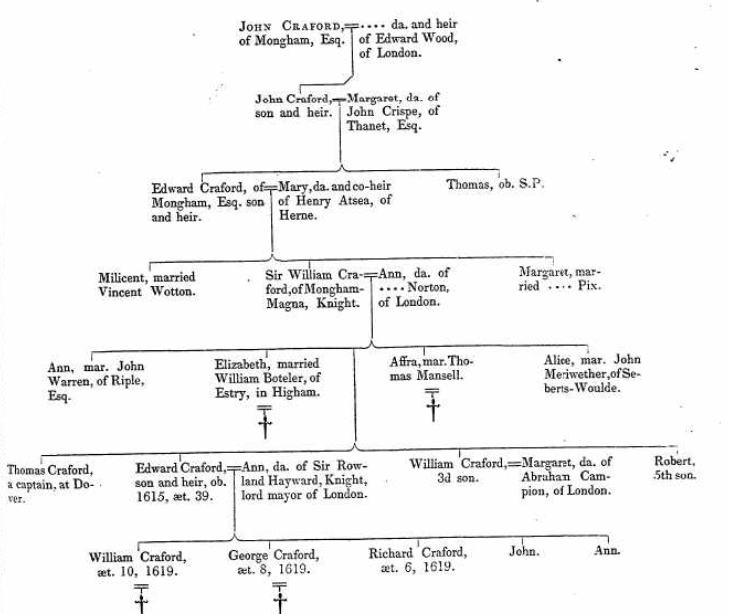
In 1530 Margaret and John had a son, Edward, who married Mary See (Atsea) and one further son, Thomas, who died without issue. Mary See is the sister of Millicent who married William Blechenden, Captain of Walmer Castle. Sadly, John Crayford died very young, when he was about 29 or 30 years old in 1535, when Edward and Thomas were still infants and is buried at St Martin’s Church, Great Mongeham. John’s son Edward Crayford also died when he was quite young in 1558 and as I understand it, at around the same time as his wife Mary leaving, according to the 1619 Visitation of Kent, three children: Millicent, William and Margaret.

The Crayford Tree from County Genealogies:pedigrees of the families of the County of Kent

Some years later, in 1636, a William Crayford is the defendent in Argent v Crayford at the Court of Chivalry. I have mentioned this in a previous post but it is worth recalling that one of the witnesses to that case is a later John Blechenden who refers to William Crayford as his “kinsman”. If he is the William Crayford born in c1609 then he would be the great-great-grandson of John Crayford and Margaret Crispe. This would make William Crayford and John Blechenden distant cousins by marriage.

UPDATE [September 2022]: I have found yet another link between the Crayford family and the Blechendens. Ann Crayford, only daughter of Edward Crayford and Ann Hayward, married Samuel Hussey and their son George married Grace Blechenden, daughter of Thomas Blechynden and Margaret Lynch. So Grace Blechenden’s mother-in-law was born a Crayford which maintained the family links until at least the mid-late 1600s.

Looking into the Crayford’s also led me via a circuitous route, to Rudyard Kipling via this: in 1505 John Crayford of Mongeham (i.e. the John who is top of the tree above) entered into a Bond with Robert Brygenden of Tenterden, yeoman about the delivery of guns to the Sovereign. For a number of reasons that I will explore later I suspect the Tenterden Brygendens/Brekendens/Blechyndens are related to the Aldington family and if so, this would demonstrate another connection with the Crayfords that predated the marriage to Margaret Crispe/Crayford. Robert Brygenden was Clerk of the King’s Ships and for reasons I haven’t quite figured out, was the subject of a short story or poem written by Rudyard Kipling – King Henry VII and the Shipwrights. I would love to know whether this is based on actual events – it seems too random not to be!

John Blechenden

Following her husband’s death Margaret Crayford married John Blechenden, one of the younger sons of William Blechenden of Mersham and Agnes Godfrey (although I now think that John is actually the eldest son of William and his second wife Margaret Fox and not of Agnes Godfrey – see William Blechynden of Mersham, d 1510). As a younger son John Blechenden was never going to inherit the lands at Ruffins Hill or Simnells in Aldington, but given that he was styled as being “of Mersham” it is possible that he resided at the family property there known as Quarington Manor. This was a medieval moated manor and had been in the Blechenden family since the 1300s when it came into the possession of Nicholas Blechenden. Hasted states that it is Nicholas’ grandson William (as mentioned above) who is the earliest owner with his name on the deeds of it that we still have today. I do wonder, however, whether William can be Nicholas’ grandson given that he wasn’t born until c1460. Perhaps he is a great or great-great-grandson.

The Blechenden’s were “an ancient family” in Kent and had by marriage extensive contacts as well as land and properties in East Kent and the Isle of Thanet. As Margaret Crayford was made a widow at a young age with two young sons but from an influential family – both her father’s and her late husband’s – it was inevitable that she would look to marry again. By that time she had also lost both her mother and her father and as one of a number of siblings it is unlikely she would have inherited much property in her own right.

Although a number of records elude me I suspect that Margaret moved back to Quekes after John Crayford’s death and that perhaps she and John Blechenden lived there following their marriage, or in a property close by, given that when John dies in 1580 his will refers to him as “John Blechinden of Birchington in Thanet, gentillman” and not of Aldington or Mersham.

John and Margaret Blechenden have a number of their own children and it seems likely that Edward and Thomas Crayford, the sons of Margaret and John Crayford, are brought up by John Blechenden and in the heart of the Blechenden family. I mention this because Sir William Crayford, Margaret’s grandson, in his will refers to his “uncle Robert Blechenden” and his “cosen George Blechenden” and this makes me think that Edward Crayford and his children, Millicent, William and Margaret, remained close to their step-siblings and cousins. Even a couple of generations later we have John Blechenden referring to William Crayford as his “kinsman” in Argent v Crayford.

Crispe memorials, All Saints Birchington

There were also clearly close family ties between the Crispes and the Blechendens. Margaret’s brothers William Crispe, in his will of 1576, refers to his “brother John Blechenden” and Sir Henry Crispe (the “little king of Thanet”) makes his “brother Blechenden” one of the two overseers to his will (in 1575). Then, when John Blechenden writes his will he specifically asks to be buried “in the netherend and northside or the chancel where Sir Henry Crispe is buried.” This is in the church of All Saints in Birchington where there are many magnificent memorials to the Crispe family. Sadly, however, I suspect John did not get his wish. John Blechenden makes his will in 1579 with probate on 30 April 1580. I haven’t found any record to suggest that John was buried in Birchington in line with his will but there is a record of a burial on the 4th April 1580 at Saint John in Thanet, Margate, (four miles down the coast from Birchington) for someone called “Bledcherden”. There is no first name or indication of gender but given the proximity and date of burial it is likely to be John. I have also found no record of a burial or will for Margaret Crisp/Crayford/Blechenden. She is not mentioned in the extract below or in either William Crispe or Sir Henry Crispe’s will which suggests she perhaps died before 1575.

Kentish wills, genealogical extracts from sixteenth century wills in the Consistory Court of Canterbury

John and Margaret’s Children

I don’t think I have seen a comprehensive list of John and Margaret’s children anywhere with their spouses and children, so I have set this out below. Birth, marriage and death records seem to be few and far between so a lot of the information has come from their wills, or those of other family members and many dates of birth or marriage have necessarily had to be estimated. And on the working assumption that Margaret would have remarried shortly after her first husbands death and had children with John whilst she was still of child-bearing age, it is likely that these were born in the 1540s possibly into the 1550s.

Henry Blechenden

Henry is mentioned in his father’s will (proved 1580) but there is little mention of him elsewhere and this is because he dies in 1583. His nuncupative will is very short and indicates that Henry died in his chambers at Staple Inn in Holborn. Staple Inn was one of the Inns of Chancery so it is likely that Henry was a barrister. His will was taken when he was “sycke in his bed in his Chamber” and states that he meant to leave his goods to his two brothers but given that his goods “were but small” he would make no will. His brothers Robert and Reynolde are named when the will is proved.

Robert Blechenden

Robert is also mentioned in his fathers will and we have a number of other records of him and his children. The Appendix to the 1592 Visitation of Kent spells out that Robert Blechenden of Whitstable married Lyddys (Lydia) Johnson, daughter of Paul Johnson of Fordwich. In 1585 Robert was made godparent to Reginald Johnson, son of Timothy, Lydia’s brother. I have assumed that Robert would be unlikely to be made godparent unless already married to Lydia and have found the following children for them:

  • Margaret – likely to have been born 1589/90 but died/buried 27 February 1589/90, Newington Next Hythe, Kent.
  • Lydia – baptised 21 Dec 1592, Newington Next Hythe (both parents mentioned on the record).
  • Robert – baptised June 26 1596, West Langdon (the Tyler Index to Parish Registers refers to Robert “Blitchends” son of “Mr Robert, gent”).
  • Martha – baptised 17 Dec 1598, West Langdon.
  • Paule – baptised 14 Dec 1600, West Langdon.
  • George – baptised 13 June 1603, West Langdon.
Reynolde Blechenden

Reynolde (Reignold/Reginald) is also mentioned in his father’s will and we have a number of records for him and his family. In 1585 Reignold marries Elizabeth Hales, the widow of William Hales. Elizabeth was born Elizabeth Johnson and is the sister of Lydia Johnson who marries Robert. Elizabeth has children by both William Hales and Reynolde Blechenden. Reynolde may be the eldest son of John and heir to his properties. We know that Reynolde was “of Mersham” and his children were baptised at Mersham. Perhaps he had inherited Quarington Manor.

We know that Reynolde dies before 1622 because, in Elizabeth’s will dated 1622, she refers to herself as “widow late wief of Reynolde Blechenden esquire deceased”. Several records indicate that Reynolde died in 1606 in Woodchurch. First, in son Thomas’ apprenticeship record Reynolde’s address is given as Woodchurch; second the Canterbury Probate Records database has a record of a will made by Reginald Blechenden of Woodchurch in 1606 with probate in the same year; finally there is a further record in the National Archives of a bond which refers to Elizabeth Blechynden of Woodchurch, widow dated 1608. We know additionally that Elizabeth’s son Edward Hales acquired the sizeable Woodchurch estates through his first marriage to Deborah Harlackenden in 1601, so it seems likely that the Blechendens moved to Woodchurch from Mersham.

Re Quarrington Manor, The History and Topographical Survey of the County of Kent, Edward Hasted 1790,

It is around this time as well that Quarington Manor in Mersham moves out of the hands of the Blechendens and to “Claget of Canterbury” and then to “Estday” and “Knatchbull”. The sale of the property would have made sense for Reynolde as his sons moved to London to pursue careers in the law and in the silk and related trades. Silk manufacture in London had rapidly taken off in the mid-late 1500s after a large number of immigrants arrived in London from the Netherlands and was a booming industry by the early 1600s.

Elizabeth and William Hales’s Children:

  • Sir Edward Hales 1576-1654 – marries first Deborah Harlackenden, second Martha Carew.
  • Elizabeth Hales – marries Robert Kenrick in 1599, St Martin’s Ludgate, London.
  • Mary Hales – marries first Simon Smith in 1604 in Woodchurch and second George Curtis.
Sir Edward Hales

Elizabeth and Reynolde’s Children:

  • John – born 1589 in Mersham. Possibly the John who is made Freeman of the Worshipful Company of Mercers in 1613. John dies in 1621 and his will helpfully makes a number of references to brothers, sisters etc.
  • Thomas – born in 1591 in Mersham. In 1604 Thomas is apprenticed to William Frith of the Worshipful Company of Habadashers in London.
  • Ralph – born in 1593 in Mersham. Has an illegitimate child Joane in 1612 who is baptised in Hackney. Marries Ann Hoaden in 1622 in St Olave’s, Southwark. They have a number of children in London and in 1631 his occupation is stated as “silkman”, i.e. a trader in silks.
  • Anne – baptised in Mersham 23 November 1595, marries William Dowman of Uffington, co Lincoln. William was the son of Edmund  of Swinhope, co. Lincoln and Jane, daughter of Thomas Hatcliffe of Hatcliffe M.P., co. Lincoln. William Dowman initiated another Court of Chivalry case Dowman v Faulcon.
  • Alice – born c1597 marries William Finch, 30 May 1615 in Hothfield, Kent. William is Mayor of Tenterden in 1614 and again in 1626.
  • Margaret – (possibly the oldest child) marries William Marriott in 1608 in Kings Sutton, Northamptonshire. No baptism record found but “sister Marryett” is mentioned in the wills of Edward Hales and John Blechenden and “son William Marryott” is mentioned in Elizabeth’s will.
Alice Blechenden

Alice may be the eldest of John and Margaret’s children given that she must be married by about 1560 to Thomas Tournay of Brockhall Manor, Saltwood. Together Alice and Thomas have fourteen children in a period of about 20 years most of whom survive infancy. Perhaps because they have so many children both Alice and her husband Thomas leave detailed wills which I will add to my Last Wills and Testaments page. These give us helpful information on their children and their spouses, grandchildren and other family and friends. Thomas Tourney’s will is dated 1592 and he died and was buried that year on 19 November. Alice’s will is dated 1596 and she died and was buried in Saltwood on 14 May 1598. Alice names her two brothers Robert and Reynolde overseers to her will.

Alice and Thomas Tournay’s Children:

  • John – baptised 1561 in Boughton Aluph in Kent. Confusingly the baptism record refers to him as the son of John, not the son of Thomas but we know Alice and Thomas had a son John, who was the eldest son and who married Elizabeth Wilkins, sister and hier of David Wilkins of Bax. John died in 1588 and predeceased his mother and father but not before he had three children with Elizabeth. She subsequently remarried John Edolph in 1592 and dawter in lawe Elisabeth Edolf is mentioned in Thomas Tourney’s will.
  • Roger – baptised 1563 in Boughton Aluph. Not mentioned in either of his parents wills so perhaps he died in infancy.
  • Bennet – baptised January 1564 in Boughton Aluph. In 1585 Bennet married the colourful Ambrose Warde (with thanks to Anne Petrie) whose father John was Captain of Sandgate Castle.
  • Anne – baptised 26 March 1565/66 in Boughton Aluph. Married William Thwaite/Twayte. Mentioned in her mother’s will and the 1619 Visitation of Kent.
  • Thomas – born 1566 in Boughton Aluph and died the same year.
  • Jane – baptised 3 August 1567 in Boughton Aluph. Jane maried Stephen Gibbes 13 February 1585 at Saltwood. Stephen Gibbes was lieutenant of Sandgate Castle.
  • Thomas – born 1568 in Saltwood, married Elizabeth Heyman (daughter of Henry Heyman) in Sellindge, Kent, October 5th 1598.
  • Margaret – born in 1569 in Saltwood, married William Collins 25 March 1591 but dies very young (in childbirth?) in 1595. Alice Tournay’s will refers to grandchildren Alice and Anne Collins.
  • Alice – born in 1571 in Saltwood, married John Baker in 1591 in Saltwood.
  • Robert – born in 1572 in Saltwood, married Alice Bargrave. Likely to be the Robert Turney of Darenth who initiated proceedings in yet another Court of Chivalry Case in 1634 Turney v Woodden.
  • Amy – born in 1573 in Saltwood, married Thomas Bedingfield of Postling 11 February 1593/94. Thomas is of the Bedingfield’s of Quidenham, Norfolk.
  • Mary – born in 1575 in Saltwood, married John Johnson on 11 October 1597 in Saltwood. John Johnson is the son of Timothy Johnson and grandson of Paul Johnson of Fordwich and also the godson of Sir Henry Crispe.
  • Katherine – born in 1576 in Saltwood and on 15 September 1599 she married Walter Mantill in Canterbury (the Mantills of Northampton and Kent are connected by marriage to the Hales’).
  • Elizabeth – baptised 16 February 1579/80 in Saltwood. Elizabeth is unmarried in her mother’s will dated 1596 and I haven’t found a clear record yet for a marriage or death. The 1619 Visitation of Kent states that she marries Thomas Reve but this is a mistake. The Elizabeth Tourney who marries Thomas Reve is the widow of the above Thomas Tourney who was born in 1568. Her memorial inscription seems to make this clear: Here lieth the Body of Elisabeth Reve ye Eldest Daughter of Ralph Hayman Esq who was first married To Thomas Tournay, Gent. by whome Shee had Issue 3 Sonnes and 5 Daughters. and, surviveing him, was remarried to Thomas Reve, Gent. but had noe Issue by Him. Whom she, alsoe surviving, dyed at The Age of 62. July The 18th 1641

Margaret Blechynden’s Last Will and Testament, 1682

Margaret Blechynden (nee Aldersey) died in c 1683. Her will was first published in 1682/3 but then republished in July 1683 “least it should be lost”. It is worth reflecting on the will because it shows that she was not just the wife of a cleric (albeit one who initially enjoyed noble and Royal patronage) but someone with social standing in her own right. When she writes her will she describes herself as being of the Parish of St Paul Covent Garden which was still at that time a fashionable part of town for the gentry and nobility. She makes no specific request about where to be buried just that she be decently buried according to the Liturgy of the Church of England. So, until a burial record comes to light we don’t know if she is buried with her husband – likely to be buried in Aldington in Kent – or in London, or perhaps with her Cheshire family.

Provision for her children in her will

There is no reference to land or properties in her will, bar a passing reference (see below), so presumably those were set out in her husband’s will. We know that her son Thomas was heir to the properties in Kent and specifically the family home in Ruffins Hill, but it is nevertheless surprising not to see some reference to this. In terms of financial provision she gives her two sons, Thomas and Theophilat “five broad pieces of Gold” each and her daughters (Anne, Mary, Margaret, Dorothy) get “five pounds a piece in silver” which are in lieu of the legacy of five pounds a piece that were in their fathers will. Clearly they never received what was in their fathers will but Magaret justifies this by saying that she is “well satisfied that I have made up to my daughters much more of their portions then ever came to my hands”.

There is a confusing passage in the will where Margaret chides her son Thomas for not being as careful as he should have been in receiving and accounting the rent of the Courtlage (the only property mentioned) and says to “supply his default” she is willing to give £200 divided into three parts but none of the thirds go to Thomas! One third goes to daughter Margaret, one third goes to Dorothy and one third to daughter Mary’s children. Mary gets no part of the £200 because her mother previously gave her £100 “besides other advantages”.

There is a further £50 which is divided between Margaret’s sons – half to Theophilat and half amongst Thomas’ children.

Gifts to wider members of the family

George Saville, 1st Marquess of Halifax, statesman, writer and politician

After the financial provision to her children and grandchildren Margaret Blechynden sets out who is to receive her jewellry and other items of value. This is interesting because it helps to confirm family relationships. The first mentioned in her will is “my Lord Halifax” who is bequeathed “the Medall of King Charles the first in gold and the small ring tied to it.”  Lord Halifax is George Savile, 1st Marquess of Halifax, the son of her cousin Anne Coventry via her marriage to Sir William Savile (3rd Baronet of Thornhill, an ardent Royalist who was killed in action in 1644). Anne Coventry was the daughter of Thomas Coventry, 1st Baron Coventry of Aylesborough, Lord Keeper of the Great Seal and Elizabeth Aldersey, sister to Samuel Aldersey. I could write much about Lord Halifax but for now will just note that he was took the popular side on the occasion of the trial of the Seven Bishops in June 1688, visited them in the Tower of London, and led the cheers with which the verdict of “not guilty” was received in court. I mention this because one of the seven bishops was the Bishop of Peterborough, Thomas White, nephew of Dr Thomas Blechynden and Rev Francis Blechynden as mentioned in an earlier post.

Margaret’s Sister Venables

The next item that Margaret bequeathes is her “biggest Diamond Ring” to her sister Venables which was their mothers. Her sister Venables is Elizabeth Aldersey who married first Thomas Lee esq. of Darnhall, Cheshire and had seven children. One of the children, her nephew Thomas Lee, is named in Margaret’s will as a sort of assistant to the Executor of the will. Elizabeth’s husband Thomas Lee died in 1642 and she eventually remarried General Robert Venables of Antrobus and Winsham. Unlike many of Margaret Blechynden’s family and friends General Venables fought on the Parliamentarian side but they did not marry until 1654.

Elizabeth’s diary has been published along with an account of the life of General Robert Venables and provides useful insights and information for family historians. General Venables died in 1687 and Elizabeth Venables in 1689.

The next item Margaret bequeathes is her large pearl ring which she gives to her son Theophilat’s wife. Unfortunately she does not name her and I have not been able to identify her. It may be an “Elizabeth” given a baptism record I have found – George Blechenden son of Theopheleck and Elizabeth Blechenden, 12 Jun 1688, in Rochester Kent – but I have no other information at this time.

sir samuel eyre

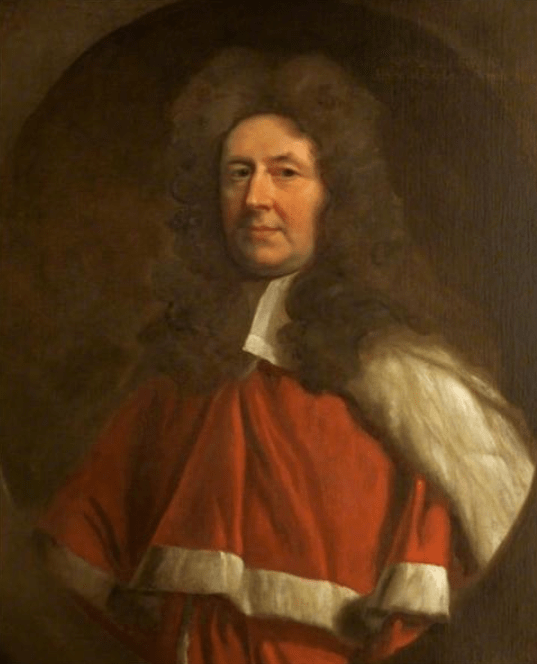
Sir Samuel Eyre

Margaret’s next bequest is to her nephew Sir Samuel Eyre, son of her sister Anne Aldersey and Robert Eyre, barrister, of Salisbury and Chilham. Sir Samuel Eyre was born in 1633, and inherited the estate of Bonhams from his great-uncle William Eyre. He was a lawyer of some emminence and one the the puisne judges of the Kings Bench. Margaret Blechynden names Samuel Eyre as her Executor later in the will and leaves to him her “small Diamond ring and my pair of Golds called a double Spur: royal”. From what I understand the gold Spur Royal was a coin struck in very limited numbers during the reign of James 1. Today only 20 are thought to be in existance. Presumably they had a rarity value when Margaret made her will in 1682 which is why she specifically refers to them unlike the “five broad pieces of gold” she gives to her sons.

Margaret also gives to Samuel Eyre’s wife her “small sapphire ring with two small diamonds”. Samuel Eyre’s wife is Martha Lucy, third daughter and co-hieress of Francis Lucy Esq (fifth son of Sir Thomas Lucy of Charlecote). Through this marriage Samuel Eyre acquires the estate of Brightwalton in Berkshire.

My Lady Thynne

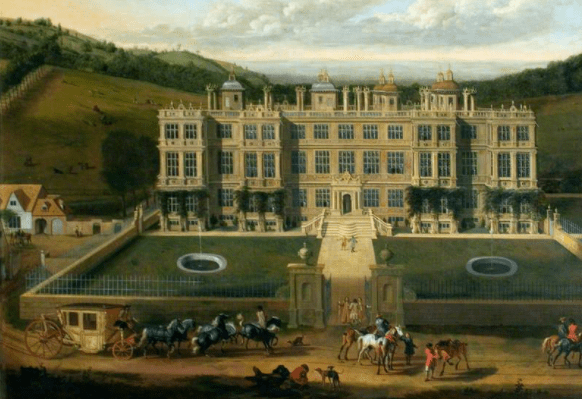
Margaret Blechynden then refers to “my Lady Thynne” and bequeathes to her a “ring of Three Diamonds and two deaths heads” which her mother gave to her. There are two possible options here. My Lady Thynne could refer to her cousin Mary Coventry who married Henry Frederick Thynne. It is possible that Mary’s mother Elizabeth Aldersey gave Margaret Blechynden a ring which she then returns to her daughter. When Henry Frederick Thynne makes his will in 1678 his wife Dame Mary Thynne is named so may still be alive when Margaret makes her will in 1682. The alternative option is that the rings were given to Margaret Blechynden by her cousin Mary Coventry/Thynne and that “my Lady Thynne” is a reference to her daughter-in-law Frances Finch who married Thomas Thynne of Longleat who became the second baronet after his father’s death in 1679/80.

View of Longleat, 1678, Courtesy of the Victoria and Albert Museum

Thomas Thynne was made 1st Viscount Weymouth on 11 December 1682 and it appears as if close family ties remained between the Blechyndens and the Thynne’s as, in his will dated 1709, Thomas Thynne mentions “his kinsman Captain Blechynden and to his son, the testator’s godson 50l. each“. Captain Blechynden is Theophilat, son of Margaret and Thomas Blechynden.

Margaret Blechynden also bequeathes to “my Lady Thynne” her french enamelled ring which was given to her by “my Lady Savile having her haires in it”.   Lady Savile is, I believe, her cousin Anne Coventry, wife of Sir William Savile and mother of Lord Halifax mentioned above. This very personal item, along with the various bequests, does suggest a close relationship between Margaret Blechynden and her surviving sisters, her Coventry cousins and their families. There are a couple of Coventry cousins not mentioned in the will that are worth mentioning briefly here: Dorothy Coventry who was famed for her intellect, her writings and her piety. She married Sir John Packington and died in 1679. Second, Margaret Coventry who died in 1649 when just 29. Her husband was Sir Anthony Ashley-Cooper, the 1st Earl of Shaftesbury. Here, close family relationships end, as the Lords Halifax and Shaftesbury became bitter political rivals and most famously debated, for many hours, the second Exclusion Bill in the House of Lords, with the eloquence of Halifax carrying the day for the King. This debate is credited with leading to the creation of the two political parties – the Whigs and the Tories.

Final Bequests

For completion, I have set out the remaining items of Margaret Blechynden’s will. Other than her children named I haven’t been able to identify the following:

  • Mrs Margaret Jones of Chester is given two pairs of Golds wrapt about a black ribbon;  
  • Her wedding ring, seven other small rings, and any remaining Golds are to be divided between her three unmaried daughters and son Theophilat;
  • Her daughter Anne receives one of Margaret’s Silver Porringers and spoons and Mr J Wight gets the other of them;
  • Mrs Tate, formerly Mrs Guyn, is given her silver tankards and her daughter her silver cordial cup and spoons.

Blechynden almshouses

Finally, after all debts being paid and funeral costs discharged Margaret leaves the “rest and residue of my Estate” to the building of a house for “Six poore Widdows and in purchasing of lands of Inheritance for their support and the repairing of the house forever”. She entrusts this final charitable act to her Executor, her nephew Sir Samuel Eyre who, in 1684, purchased a site in Winchester Street in Salisbury for £120 10s. and built the almshouse on it for £99 15s. 9d.. I understand that these are still operational today and provide sheltered accommodation.

Rev. Francis Blechynden, 1601 – ?

Today’s post is to record what I know about Francis Blechynden, son of Humphrey Blechynden of Aldington and younger brother of Dr Thomas Blechynden.

Francis was born in Aldington in Kent where he was baptised on 3 May 1601. Although a younger brother and Humphrey’s third son he also had the opportunity of a good education and followed his brother Thomas to St John’s, Cambridge receiving his B.A. in 1621-2; M.A. in 1625 and B.D. (Bachelor of Divinity) in 1631. Like his elder brother, Francis entered the Church and was ordained a priest at Upton Chapel in Northamptonshire on 9 June 1628.

I’m not sure, however, that Francis entered “active service” as it were, as we know from The Oxinden Letters that Francis was at Cambridge and tutoring James Oxinden there between 1629-31 where it would appear that it was a constant battle to get Henry Oxinden to provide for his brother James which often left Francis putting his hand in his own pocket:

….I feare my owne purse againe must satisfie his wants, which will hardly supplie mine owne. Wherefore lett me intreat you not to lett the Carriar returne from you empty handed, and since I have undertaken to be a petitioner unto you, lett me further intreat you to furnish your brother with a winter gowne;

“The Oxinden Letters” (archive.org)

There is an interesting reference in the Oxinden Letters to an outbreak of the plague in Cambridge in 1630 which forces the college to close down and for “both fellowes and schollers, to depart“. Francis later writes that between March and November of that year “343 people have dyed or suspected to have dyed of the Plague.”

In 1631 Francis writes that “Urgent occasions doe now call me from the Universitie into west contrye, and as yet I know not how long or how litle while I shall stay there, wherefore I have thought fitt to convertt your Brother to another man’s Tuition..”. I haven’t been able to discover what the “urgent occasions” might have been although his brother Thomas held a couple of livings in the “west countrye” at this time – at Sowton in Devon and Norton Fizwarren in Somerset.

St John’s College c1685

Francis Blechynden was appointed Vicar of Ospringe in Faversham, Kent in 1638 but this is a short term post as he resigned in 1639 and was replaced by Thomas Mason in February 1640. This was an appointment essentially made by the College who held the ability to appoint to the post and benefit from the revenues etc from lands in the parish. The probable reason for his resignation was his impending appointment in 1640 as a Fellow of St John’s College. He also held the post of Bursar in 1643/44 and was made a Senior Fellow on 21 July 1643.

Thomas White

Whilst at Cambridge Frances stood surety to at least three students who were admitted “sizar” which I understand to mean that they had a form of scholarship on the basis that they undertook defined work around the college. One of these students was his nephew Thomas White, the son of his sister Anne who, when her husband Peter White died, went to live with Sir William Brockman. It is interesting to note that Thomas White is admitted to Cambridge at the age of just 14 on 29 October 1642 just a few short weeks before Dr Thomas Blechynden and Sir William Brockman, along with many others, would be imprisoned in Winchester House at the start of the Civil War. I wonder if Anne was removing her only son from what might have been a tense situation at home to the relative calm of Cambridge and the care and protection of her brother Francis?

Thomas  White,  son  of  Peter  White, ‘plebeii,’  lately  deceased, of  Allington,  Kent ;  born  at  Allington ;   school,  Wye,  Kent  (Mr Suerty-on-high  Nichols)  for  3  years;  admitted   sizar,  tutor  and surety  Mr  Blechendyn,  29  Oct. 1642  aet  14.

Admissions to the College of St John the Evangelist in the University of Cambridge, Parts I II, Jan 1629/30 – July 1715

Thomas White is worthy of his own blog post, rising to the position of Bishop of Peterborough, tutor to Princess Ann and “all England indeed looked anxiously to him as the person on whose influence the religious principles of their future sovereign in a great measure depended“. But despite this he ended up in the Tower of London for refusing to take the new oaths of alligiance (seems to run in the family!), was stripped of his bishopric and his living and died a few short years later. His will is helpful as it name-checks a large number of people including many Blechynden relatives.

Ejected from the College

From what I have found to date it looks as if Francis Blechynden had settled upon a career in education and learning but this was abruptly brought to an end in 1644 when, like his brother Thomas, the English Civil War changed the course of his life. As part of the puritan reforms it was seen as necessary to ensure that the Universities were compliant and supportive. The Earl of Manchester was empowered by Parliament to ensure reformation of the college and he ejected the Master of St John’s, William Beale, and then arrived at the college to appoint a new one, John Arrowsmith. Unlike other appointments the records note that Arrowsmith was made master by the Rt Hon Lord Earl of Manchester by the authority of parliamentary ordination.

As part of his appointment Arrowsmith had to take an oath which would provide for the “perfect reformation both of the College and University” which also became a requirement for the Fellows, including Francis, together with swearing to uphold the doctrines enshrined in the Solemn League and Covenant. Not all felt able to agree to this and many Senior Fellows and Fellows were summarily ejected from their posts at the College.

…which with the Covenant not being of easy digestion, several of the Fellows were ejected, beginning with the seniors Mr Thornton, Bodurda, Tirwhit, and Blechenden, men of good worth;

History of the College of St John the Evangelist, Cambridge by Thomas Baker – Part 1
Print of the Solemn League and Covenant, courtesy of the British Museum

The trail for Francis goes cold after he is ejected from St John’s College. There is one reference to a possible appointment to a new living at Brenzett in Kent, on the Romney Marsh. The National Archives has the following record:

24 November 1646 — Application for an order for Sir Nathaniel Brent to institute and induct Francis Blechinden to the vicarage of Brenzett, Kent, on the presentation of Sir William Brockman.

https://discovery.nationalarchives.gov.uk/details/r/e50ebea8-ae68-45e9-a76e-366bcc33eb3f

However, there is no evidence in the Clergy Database that Francis became Vicar of Brenzett and perhaps the presentation by Sir William Brockman – a staunch Royalist – went against him. After this, I have found no further records that can be ascribed with certainty to this Francis, the brother of Dr Thomas, son of Humphrey and Mary, educator and sometime vicar.

There is a burial record for a Francis Bletchenden dated 19 March 1672/73, St George the Martyr, Southwark and perhaps this is him. Other members of the family had moved out of Kent and were now living in London or its outskirts. But Francis is a family name and this record could also belong to the Francis who was born in the City of London in 1642, son of Ralph Blechenden. For now, at least, what happened next for Francis Blechynden is a mystery.

Thomas and Margaret Blechynden – the impact of the English Civil War

This second post on Dr Thomas Blechynden and his wife Margaret focuses on the civil war years and beyond. For the first post click here.

The start of the English Civil War in 1642 was a difficult time for Thomas and Margaret Blechynden and their four young children. Thomas was summarily ejected from the clergy and his living as Parliament sought to overhaul the Church of England and make it less “popish”. This process had already started following the arrest of the Archbishop of Canterbury, William Laud, in 1640 on a charge of Treason. These were febrile times.

Archbishop Laud had been an ally of Thomas and had intervened personally to help him secure a position at Canterbury Cathedral through the patronage of King Charles I. There is no evidence that Thomas was overtly “Laudian” or that he wanted the Church of England to move more closely to Rome although it seems fair to assume, given his Royal patronage that he was a supporter of the Monarchy. On the other hand we know that he married into a well-connected family with strong Puritan sympathies and it seems likely that Thomas was at least open to some of the new ideas and perhaps therefore walking a difficult theological tightrope.

Regardless of Thomas’ personal faith wider events took over when the King left London and raised the Royal Standard at Nottingham in August 1642. Senior members of the clergy of the Church of England were ejected from their posts and replaced with new men; land and revenues were sequestered by Parliament and many, including Thomas, were charged with being a delinquent. As early as October in 1642 Parliament was looking to seize the livings of members of the clergy, as well as the aristocracy, to support their cause:

Sequestration of Delinquents Estates. 14 Oct 1642

Resolved, &c. That the Fines, Rents, and Profits, of Archbishops, Bishops, Deans, Deans and Chapters, and of such notorious Delinquents, who have taken up Arms against the Parliament, or have been active in the Commission of Array, shall be sequestered for the Use and Service of the Commonwealth. The Manner of the Sequestration is referred to the Committee for sequestring the Estate of the Lord Capell.

‘House of Commons Journal Volume 2: 14 October 1642’, in Journal of the House of Commons: Volume 2, 1640-1643 (London, 1802), pp. 807-809. British History Online http://www.british-history.ac.uk/commons-jrnl/vol2/pp807-809.

For members of the clergy this was an anxious and unsettling time, many were subjected to violence and had to witness acts of vandalism and iconoclasm. There is even a record of the personal impact of this on Thomas and Margaret which must have taken place in Canterbury before he was ejected from his living there and most likely to be the “Disorders committed at Canterbury, by the Soldiers” referred to in the House of Lords on 10 September 1642. Given that their daughter, also Margaret, was baptised on 4 December 1642 it is possible that Margaret was heavily pregnant at this time. This passage leaves me with the impression that Thomas was probably scared for his life and that of his young wife:

when she saw a man strike at the Image of Christ lying in the manger, she skreet out and ran to her husband, who came … and pleaded for the Images, … and while this prebend was disputing … he grew very sicke, and was faine to go out of the Cathedral.

Thomason Collection of Civil War Tracts

Imprisonment and delinquency

On 21 November 1642 the war became even more personal for Thomas and Margaret as Parliament resolved that “several Gentlemen of Kent … as persons disaffected to the Peace of the County, and of the Kingdom… shall be forthwith committed Prisoners to Winchester House, there to remain during the Pleasure of the House.” The Gentlemen of Kent are noted as: Sir Anthony Ager, Sir John Fotherby, Sir Thomas Wilford and his Son, Mr. Geo. Chute, Mr. Anthony Hamond, Dr. Blechenden, Dr. Horsmanden, Mr. Henry Deering, Mr. Paynter, Mr. Smyth.

However, it would seem that this was overturned but then reissued one week later on 28 November with, I think, a rebuke to the Committee for the Safety of the Kingdom:

Prisoners remanded

Ordered, That Sir Jo. Fotherby, Dr. Blechenden, and Mr. Painter, committed Prisoners to Winchester House, by a former Order of this House, and released by a Warrant from the Committee for the Safety of the Kingdom, be forthwith remanded to Prison to Winchester House: And the Committee for the Safety of the Kingdom is to take Care herein. 

‘House of Commons Journal Volume 2: 28 November 1642’, in Journal of the House of Commons: Volume 2, 1640-1643 (London, 1802), pp. 866-868. British History Online http://www.british-history.ac.uk/commons-jrnl/vol2/pp866-868
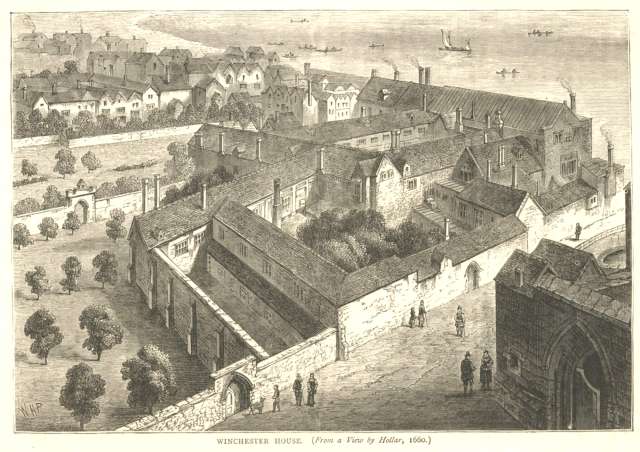
Winchester House in 1660

Winchester House was taken from the Bishops of Winchester, who had owned this site on the Southbank of the Thames for many centuries, at the start of the war. The House was used as a prison for Royalists until after the war, when it was sold off. It is perhaps not totally surprising that Winchester House should be used as a prison given that it already had a small but notorious prison within its grounds: the Clink! A name now synomymous with all prisons.

It is unclear how long Thomas languished in Winchester House. In January 1643 the House of Commons resolved that “Dr Blechenden and Dr Baker be forthwith sent for, as Delinquents”. But does this mean he was still imprisoned in Winchester House at this time? This is unclear although from letters written by Sir William and Lady Ann Brockman we know that conditions in Winchester House were far from ideal. The Blechynden’s were related to the Brockman’s and Thomas’ sister Anne had been living with the Brockman’s since the death of her husband Peter White. Sir William was sent up as prisoner on 28 November 1642 and committed to Winchester House on 2nd December so may have been living in close quarters with Thomas Blechynden. We know that Sir William was imprisoned for some time as Lady Ann Brockman pleads for her husband to be moved to a prison close to home fearing for his health on 7 Feb 1644:

Feb 7 1644
The Humble petition of the Lady Brockman to the Honourable Committee for the Parliament Affairse in Kent

Sheweth, that whereas my deare husband hath been a prisoner in Winchester house,4 London for the space of thirteene monthes, and upwards: I am bold to crave this lawfull favour at your hands, that you would vouchsafe to use such meanes as your wisdome shall prompt unto you, for his Removall from thence to Ostenhanger where he may be secured as well as there, under the Gouvernement of the Hon’ble Sr Edward Scott.

The maine end I aim at in this request is only the preservation of his health, wch I feare may be in some danger through the multitude of prisoners committed lately to that place from Arundell Castle, to the number oone hundred and upwards of wch companie divers have dyed since soe I commend this businesse to your serious and charitable consideration wherein if you shall gratify me I shall remaine gratefull to you and always pray for your welfare,
Ann Brockman

https://www.kentarchaeology.org.uk/Research/Pub/ArchCant/132-2012/132-02.pdf

I have not yet found a record for Dr Thomas Blechynden of the outcome of the accusation of delinquency. “Delinquents” were those who supported the monarchy in the Civil War or who were “papists” or “recusants”. The National Archives explains that following an accusation of delinquency, if well grounded, the estate in question was seized and held until the accusation could be investigated. If the delinquency was proved to the satisfaction of the committee the delinquent was deprived of his whole estate, one fifth being, however, allowed to him for the maintenance of his children, and one fifth of the proceeds of the estate being allowed to the informer.

Therefore, just the accusation of delinquncy could mean that lands were held for months or years until the question was resolved. Although I have found no evidence that Dr Thomas Blechynden was a proven delinquent or had his estate sequestered it would appear that he remained in prison as his brother Richard, in August 1644, bailed him out but on the condition that he wasn’t allowed to travel far without consent and certainly not back to his estate in Ruffins Hill in Aldington:

Bond of Thos. Blechenden of London, S. T. P., Robert Crane of Whitecross-street, and Richard Blechenden of Paternoster-row, in 500l. to the Serjeant-at-Arms, John Hunt, conditioned that Dr.-Thos. Blechenden shall not go above three miles from London without consent of the Committee for Prisoners.

Charles I – volume 502: August 1644′, in Calendar of State Papers Domestic: Charles I, 1644, ed. William Douglas Hamilton (London, 1888), pp. 387-465. British History Online http://www.british-history.ac.uk/cal-state-papers/domestic/chas1/1644/pp387-465

It is worth reflecting that 500l , or £500, is a significant amount of money to raise. Today this would be worth about £60,000. An evaluation of Thomas’ estates in 1650 assessed them at £200.

Execution of the Archbishop of Canterbury

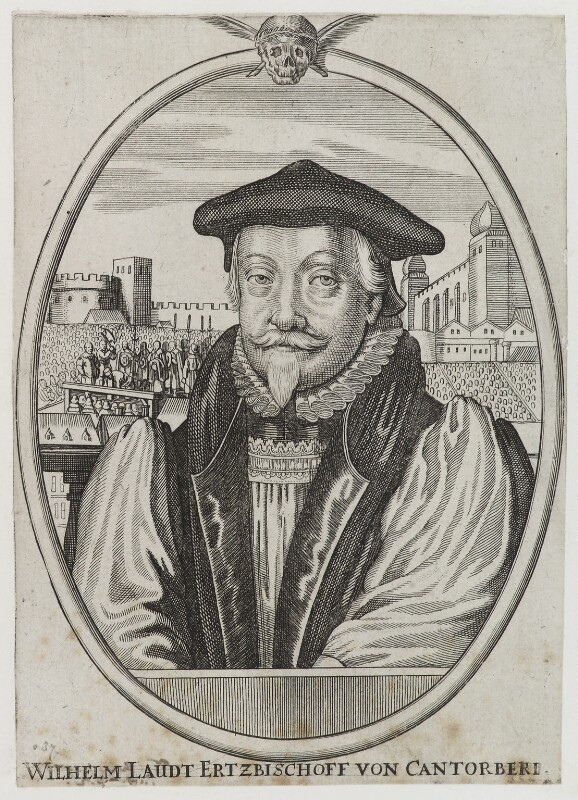
Archbishop William Laud with image of his execution in the background

In March 1644 the long trial began of Thomas’ former ally, William Laud the Archbishop of Canterbury. Laud was a controversial figure, a staunch supporter of the King and had sought to combat Puritanism during his tenure as Archbishop of Canterbury. He was arrested on charges of High Treason but managed to successfully prove that he had not committed treason under known law. Therefore, as with Thomas Wentworth the Earl of Strafford, he was held to have subverted the constitution, and he was condemned by bill of attainder. Laud was executed at Tower Hill on 10 January 1645 at the age of 71.

It is impossible to know what personal impact the execution of William Laud had on the Blechynden’s. Thomas had spoken in his defense regarding the practice of bowing towards the altar which the puritans argued was evidence of Laud’s popish proclivities. Thomas argued that the practice had been in place for some time and ever since his own installation which took place “above ten years ago”. Regardless of his personal views the beheading of the Archbishop of Canterbury must have been a shocking event and deeply unsettling for the Anglican clergy who had been ejected from their livings in 1642.

Kentish Rebellion – what next?

On Christmas Day in 1647 the people of Canterbury decided they had had enough of puritan austerity. They wanted to celebrate Christmas and have a day off work and this led to what was known as the “plum pudding riots”. Although over relatively quickly it sowed the seed for the Royalist uprising in Kent that took place in May 1648. Again, the uprising was quashed this time with some force by Lord General Fairfax at the Battle of Maidstone on 1 June 1648.

The Kentish Rebellion began as a “humble petition of the Knights, Gentry, Clergy and Commonality…” and there is a suggestion that Thomas Blechynden was involved. Although initial charges made in 1648 were dropped the County Committee for Kent, on the 9th of October 1650, sent to the Committee for Compounding “a list of the estates of recusants and others which we have seized according to your instructions, and will transmit the charges and proofs against them as soon as transcribed” and amongst the estates seized of “delinquents in the late insurrection” was that of Dr Blechynden with a yearly valuation of his estate at £200.

Information was then provided on 7 Nov 1650 by Solicitor Thomas Fowle that Thomas Blechynden “promoted the late libellous and seditious petition of Kent, aided the late insurrection, was at several assemblies, and was in arms against Parliament” to which accusation Thomas defended himself or, rather his wife Margaret did, as it is she that she writes to the Committee for Compounding to challenge the case against him which she does successfully.

14 Nov. 1650. Order on his request that the County Committee give him a copy of the charge against him, and allow him to examine witnesses in his defence. They are also to send up a copy of the old charge of delinquency exhibited to the late County Committee against him.

10 Dec. He begs discharge, unless further cause appear against him. Was accused in 1648, and compounded with the County Committee, who discharged him, but now the County Committee revive the very charge from which he was acquitted. Signed, Margaret Blechinden.

10 Dec. His sequestration discharged, there being no convincing proof of delinquency.

Cases before the Committee: November 1650′, in Calendar, Committee For Compounding: Part 4, ed. Mary Anne Everett Green (London, 1892), pp. 2595-2635. British History Online http://www.british-history.ac.uk/compounding-committee/pt4/pp2595-2635

In March 1649 Thomas makes his will in which, according to The Blechynden Story, by E.M. Hall and H.V. Hall, he “bemoaned the unnatural wars and years of sequestration“. Perhaps it is telling that he makes his will after he had been suspected of involvement in the Kentish Rebellion and shortly after the execution on 30 January 1649 of King Charles I outside the Banqueting House, Whitehall. It was many years before his will was proven on 23 February 1663 so perhaps Thomas was seriously ill in 1649/50 which is why Margaret also writes to the Committee for Compounding on his behalf. Or had the years of imprisonment and suspicion taken their toll and after witnessing the executions of both Archbishop Laud and the King, Thomas decided to plan ahead and provide for his wife and children in case worse was to come?

I am conscious that I have not spent much time in this post on Margaret Aldersey. The civil war years for her must have been challenging especially, if like Lady Brockman, Thomas was imprisoned for a significant amount of time or at least unders suspician and investigation. Writing to the Committee for Compounding in 1650 shows strength of character and I imagine, like Ann Brockman, she lobbied on her husbands behalf to get him home or at least to a prison nearer home. Her will points to interesting family connections and, well frankly money, as she distributes her gold, diamonds and pearls amongst her family. But she also sets up through her will almshouses for “six poor widows” to be maintained “forever” and these are still operational today providing sheltered accommodation in Salisbury!

Dr Thomas Blechynden eventually gets to go home to Ruffin’s Hill and spends the remainder of his days there dying in 1662 or 1663 – his death and burial record eludes me but his will is probated in 1663. Margaret Blechynden outlives her husband by 20 years and her will (1683) records that she is living in the parish of St Paul’s, Covent Garden, in the County of Middlesex (now central London). Margaret’s will is worth looking at separately to explore her wider family connections. So I will follow that up shortly but end this one with a quick summary of their children:

Children of Dr Thomas Blechynden and Margaret Aldersey:

  • Ann – eldest daughter, baptised 23 Dec 1636 Canterbury Cathedral, mentioned in her mothers will of 1683, still unmarried at that time.
  • Mary – second daughter, baptised 7 Jan 1639/40 Canterbury Cathedral. Marries Edward Dilkes (possibly related to the Dilkes of Maxstoke Castle, Warwks). Her mother’s will refers to Mary’s “children” and she and her children are also referenced in her cousin Richard Blechynden’s will dated 1697.
  • Thomas – eldest son and heir, baptised 12 Mar 1640/41 Canterbury Cathedral. Marries Marie Cartwright in Dulwich and has a number of children.
  • Margaret -baptised 4 Dec 1642 (note this is just a few days after the House of Commons orders her fathers imprisonment). Never marries. Will proven in Chester 20 April 1713.
  • Dorothy – no baptism record found. Mentioned in her father’s will so born before 1649. Never marries. Will proven in Chester in 1717.
  • Theophilact – no baptism record found but mentioned in his father’s will so born before 1649. His mother’s will of 1683 refers to him and his wife (Elizabeth Garland?) and his cousin Richard’s will (1697) refers to “Captain Theophilus Blechynden and his wife”.

Dr Thomas Blechynden and Margaret Aldersey

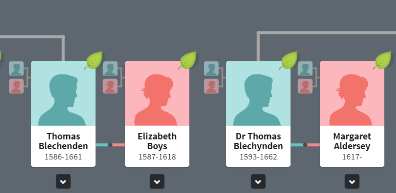
This post will focus on Thomas Blechynden, Doctor of Divinity, and his wife Margaret Aldersey. Dr Thomas Blechynden was a distant cousin of Thomas Blechenden. They were direct decendents of James Blechenden but decended down the lines of his two wives. The Thomas Blechenden who married Elizabeth Boys inherited the family home of Simnells in Aldington in Kent and the Thomas Blechynden who married Margaret Aldersey inherited Ruffyns Hill in Aldington.

The extract from my ancestry tree shows that they were of the same generation and, as contemporaries who died just a year apart, they lived through the same political and religious upheaval. But their lives took a very different path. Thomas Blechenden studied law at Gray’s Inn and was involved in public affairs in Kent but lived relatively quietly whilst Dr Thomas Blechynden studied at Cambridge, entered the Church, enjoyed Royal patronage but who was also thrown into prison at the start of the Civil War in 1642.

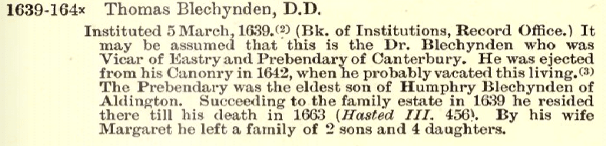
Thomas Blechynden was the eldest son of Humphrey Blechynden and Mary Toke and the eldest of eight children (not all of whom survived infancy) . He was born in Aldington in Kent and baptised at the local Church in January 1592/3. As the eldest son of a well-connected country gentleman Thomas would have received a good education and in 1609, when Thomas was 16 he went to study at St John’s, Cambridge, receiving his B.A. 1612-13. Thomas continued his studies and received his M.A. in 1616; B.D. in 1624 and D.D. in 1635. D.D. is the degree of Doctor of Divinity. This is the highest of the degrees awarded by the universities of Oxford and Cambridge. It often appears in the sources as ‘STP’, that is Sanctae Theologiae Professor. It also sometimes appears as ‘Theo. dcr.’ and as ‘STD’ (Sanctae Theologiae Doctor).

So, it would seem that Thomas Blechynden had no interest in managing the family estates and headed instead for a career in the Church. Following his ordination in Peterborough Cathedral on 23 May 1619, and whilst still a Fellow of St John’s, he was appointed household Chaplain to Francis, Lord Russell of Thornhaugh, 4th Earl of Bedford. Through his patronage he was appointed Rector of Sowton in Exeter in 1625, a position he held for the next 10 years. In 1627 he was also appointed Rector of Norton Fitzwarren in Somerset via the patronage of Edward Bourchier, 4th Earl of Bath, a position he held until 1638.

The Earl of Bedford was heavily involved in the programme to drain the Fens and correspondence survives between The Earl of Bedford and Sir Henry Vane, Ambassador at the Hague about this. There is an interesting element to the letters which indicates the close relationship between Thomas Blechynden and the Earl and Countess of Bedford as it would seem that the Earl planned to settle two of his younger sons in the “Low Countries” and the Countess asked Thomas to go with them and see them settled there. Perhaps accompanying the children abroad wasn’t in the job description of household Chaplain as the Earl, in his letter of 25 July 1630 to Sir Henry Vane, says he “hopes this will not be a cause of misunderstanding between him and Mr. Blechenden.

There is also a letter dated 2 November 1630 from Thomas Blechynden to Sir Henry Vane which suggests that he was, or was angling for, a position as Sir Henry’s chaplain. The letter also passes on news from the Earl about the work to progress the draining of the Fens. Here is a summary of his letter from the Calendar of State papers (and a slightly fuller version is also here):

On 17th October, the Earl of Bedford countermanded former directions for the writer to see his two sons to Leyden, because the Lord Treasurer had made some alteration in the business of the Fens, which reason of delay is to the writer a mystery. Would have waited upon Sir Henry as chaplain, but was informed from “my Lady” that Mr. Vane had gone over in that capacity. If Sir Henry commands the writer to attend him in the States, begs the favour of a previous letter to the Bishop of London. Congratulations on the birth of a son. P.S. dated the next day adds, that a fresh letter from the Earl of Bedford explains that the stoppage in the business of the Fens arises out of a misunderstanding of Vermuyden’s former proceedings; but he is well esteemed here, and the business of draining is now conceived so feasible, that the Earl will have sharers sufficient in England to carry him through that vast undertaking. He will reserve a considerable quantity of acres for Sir Henry.

‘Charles I – volume 175: November 1630’, in Calendar of State Papers Domestic: Charles I, 1629-31, ed. John Bruce (London, 1860), pp. 371-396. British History Online http://www.british-history.ac.uk/cal-state-papers/domestic/chas1/1629-31/pp371-396

It would seem that Thomas was made chaplain to Sir Henry Vane, as in 1631/2 a letter from Bishop Laud to Sir Henry refers to Thomas as “Sir Henry’s Chaplain”. The letter suggests that Laud held Thomas Blechynden in esteem or, as a minimum, held Sir Henry in esteem and wanted to assist his chaplain.

My very good Lord, I wish you all health and happiness in your employment. I shall according to my promise, take all the care I can for Mr. Blechenden’s business. But sure, if Dr. Anyon have denied Dr. Hunt his dividend in the church of Canterbury, it is not with any eye to Sir Henry’s chaplain, but to increase their own dividend; for it hath been the custom in that church, and in some others, to allow some small proportion to him that lives absent, and when the audit comes, to share the remainder among themselves, towards their charge of housekeeping upon the place. And howsoever, if they refuse to give the Dean of Durham anything at all, yet Mr. Blechenden cannot challenge any part of it, being as yet no prebend there. And whosoever caused your Lordship to write in that way did much deceive both himself and you. For the business, if I live to see the place made void, I shall fail in no point of trust, but be ready to move His Majesty for Mr Blechenden.

Letter CCXXXV to Sir Henry Vane, January 27 1631/2. Scott, W., Bliss, J., Laud, W. (1860). The Works of the Most Reverend Father in God, William Laud, D.D. Sometime Lord Archbishop of Canterbury. United Kingdom: John Henry Parker.

Royal Patronage

I find the comment made by Bishop Laud that Thomas Blechynden was “as yet no prebend” puzzling. The very useful Church of England Clergy database says that on 14 September 1631 that he was presented for appointment to the Prebendary of Canterbury Cathedral and this time his patron was King Charles I. It is possible that the Bishop rejected the presentation, but is that likely given the King was the patron? Whatever the matter here, Thomas was presented again by the King on 15 November 1633 by which time William Laud was the Archbishop of Canterbury and this time there seems to be question of Thomas’ appointment. Notes to the presentation indicate that Thomas was “royal chaplain in ordinary to King Charles” which would have been a largely honorary, albeit still prestigious, role but could have meant he preached occasionally at the Royal Chapel or to other members of the Royal family. Royal patronage and the support of the Archbishop of Canterbury could have set Thomas Blechynden on the path to much greater things if it wasn’t for the Civil War and, by 1649, the execution of both Archbishop Laud and King Charles.

In addition to his position as a prebend of Canterbury Cathedral in 1638 Thomas Blechynden was appointed Perpetual Vicar of Eastry with Worth and in 1639/40 Vicar of Kingston, Kent. The Parish Registers of St Giles make reference the Return of the Churchwardens to the Visitation in 1640 with a note on “Dr Blechindin” which helps confirm his recent appointment there:

“Dr. Blechindin’s Chancel wants Tyling, and it doth rain in upon the Communion table.”

The Parish Registers of S. Giles, Kingston by Rev. Christopher Hales Wilkie, published 1893

Both of these later positions – in Eastry and Kingston – he held until his death in 1662 although it is unknown whether he had access to the livings from these two parishes during the Commonwealth. The Parish Registers of S. Giles, Kingston by Rev. Christopher Hales Wilkie, are also helpful in that they contain a short biography of Thomas Blechynden D. D. which helps to provide further evidence of his family:

There is one further possible appointment in Esher as there is a letter from Thomas Blechynden to William Dell, Secretary to Archbishop Laud, about a “insolent work of darkness” which took place in the Church to remove the altar rail and which names a number of suspects. Thomas refers to a witness to the act Katherine Gill, a “poor woman” of “ill life and fame” and there is an unsettling, unchristian threat made in the letter which does not make me think highly of him:

I shall labour to have her confess it to some other; she is threatened with the pulling down of her house, and subtraction of maintenance when I am removed to Canterbury.

Charles I – volume 460: July 14-23, 1640′, in Calendar of State Papers Domestic: Charles I, 1640, ed. William Douglas Hamilton (London, 1880), pp. 475-508. British History Online http://www.british-history.ac.uk/cal-state-papers/domestic/chas1/1640/pp475-508 

Margaret Aldersley

Thomas Blechynden spent his early years in study, advancing his career and building up a network of powerful friends and allies. By the time he was 41 he was prebendary to Canterbury Cathedral with no less than the Monarch as his patron and an ally in the Archbishop of Canterbury William Laud. His attention then turned to marriage, and perhaps recognising the need for a future heir to the family estate he turned his eye on young Margaret Aldersley. They were married in 1635 when he was 42 and she just 18 years old!

Thomas and Margaret’s license to marry

Their marriage license is difficult to read but it says something like: “Which day appeareth formally Thomas Blechynden one of the prebendary of Christ Church of Canterbury bachilour aged 42 years and allegedly he intendeth to marry with Margaret Aldersey of the parish of St Katherine Coleman Street London maiden aged 18 years  and the lawful and real daughter of Samuel Aldersey merchant deceased, and she at y disposal  of her mother-in-law [i.e. step-mother] Margaret Aldersey who consents to this intended marriage.  And of the month …. Also that there is no lawful lot or impediment by reason of any existant …….affinity or otherwise to hinder the so intended marriage ho made faith and do first …. to be married in the church  of St Faiths London or in ye …Church of St Leonard Foster Lane London….”. The marriage was attested to by Thomas’ younger brother Richard Blechynden who is a silkman living in Paternoster Row, close to Saint Paul’s Cathedral in the City of London.

Margaret Aldersey was the daughter of Samuel Aldersey of Bunbury in Cheshire an influential and generous member of the Habadashers Company who died in 1633 and was buried in the Chancel of St Stephen’s, Coleman Street. St Stephen’s was destroyed in the Great Fire of London in 1666, rebuilt by Sir Christopher Wren but destroyed again in the blitz, 29 December 1940 but there is happily, the following record of his burial:

In the Chancel lies buried the Body of Mr. Samuel Aldersey, Merchant Citizen and Haberdasher of London, July 25. 1633. His Hatchments and Ensigns proper to his Name and Estate, hang over him.

John Strype’s A Survey of the Cities of London and Westminster, Coleman Street Ward [Monuments]Vol 1, 1753

We should take a moment to pause on Samuel Aldersey and the significance of St Stephen’s in Coleman Street as it speaks volumes about the type of person that Margaret probably was and the family that Thomas was marrying into. The parish of Coleman Street was a notorious hotbed of religious radicalism – not only in the parish church of St Stephen’s but in the merchant houses and the taverns and inns nearby. Samuel Aldersley was at the centre of that in the early 1600s. He was well known by the Dutch community in London (his first wife, Mary Van Oyrel, was Dutch) and also by the elders of the Dutch Reformed Church. Samuel was a vestryman at St Stephen’s and helped to appoint the leading Puritan minister John Davenport to the Church in 1624. Samuel Aldersey was also one of the three founding members of the Massachusetts Bay Company which was formed in 1628 as a joint stock venture to trade in the fish and furs of New England but leading members of the company also wanted to use it to promote the founding of a Puritan religious commonwealth.

Sir Norton Knatchbull and Mary Aldersey, 1629

Samuel’s sister Mary married firstly Thomas Westrow, Alderman of London and secondly Sir Norton Knatchbull (not to be confused with his nephew also Sir Norton Knatchbull, Baronett, who as a “dear friend” is one of the overseers of Thomas Blechynden’s will) and we can assume therefore that they knew each other well. People seemed to move in quite small social circles and I found it interesting to note that Sir Norton’s first wife was Ann Wentworth, eldest daughter of Paul Wentworth who was in turn the brother of Peter Wentworth, grandfather to Elizabeth Boys, and the wife of the other Thomas Blechenden mentioned at the start of this post. Sir Norton Knatchbull, Baronett, also married Dorothy Westrow, the daughter of Thomas Westrow and Mary Aldersey, shortly after Mary remarried to Sir Norton Knatchbull (senior).

Thomas and Margaret’s children

Thomas and Margaret married in 1635 and quickly had children, six in total: Anne (bap 1636), Mary (bap 1640), Thomas (bap 1641), Margaret (bap 1642), Theophilact and Dorothy. The first four children are all baptised at Canterbury Cathedral -appropriate given Thomas’ position as a prebendary of the Cathedral – but I have not been able to find baptism records for Theophilact and Dorothy.

Things probably started taking a worrying turn for Thomas in 1640 when Archbishop William Laud was arrested for Treason and I would imagine questions were asked about his friends, family and those he appointed to prominent positions. The start of the English Civil War started in earnest on 22 August 1642 when King Charles left London and raised his standard in Nottingham with the first battle at Edgehill in October that year. This changed everything for Thomas and Margaret. He lost his position at Canterbury Cathedral and later in 1642 by order of the House of Commons was ordered to be remanded to prison.

Although we don’t know where Theophilact and Dorothy were baptised during this period of war, disruption and uncertainty, it is perhaps telling that the name of his youngest son means “guarded by God”.

The Civil War years and beyond will be covered in my next post.

My Boys Family Connection

Today’s post reflects on the links between the Blechendens and Boys family in Kent. I almost entitled this post “my connection to Boys” but thought better of it when I realised that it might attract the wrong sort of internet traffic! Anyway, back to the serious stuff. I have tracked down quite a large number now of my direct ancestors in Kent, England, including one directly back to the Boys/Boyes/Bois family in Kent through the marriage of John Wanstall to Hannah Boys in Waldershare, near Dover in Kent, in 1735.  Hannah Boys is a descendent of  Thomas Boys of Bonnington (d 1508) who married Thomasine.  Through this line I can take the family tree further back to c1066 – thanks to the large amount of research that has gone into this family already.

William Boys and Isabella Phallop brass plate at Holy Cross Church, Goodnestone

The photo on the left was taken earlier this year when as a special wedding anniversary treat my husband took me on a hunt of my Kentish ancestors. The rest of our family think we are mad but I was thrilled to find this brass plate on the floor of the Church of the Holy Cross Goodnestone dedicated to my 14x great grandparents William Boys (d1507) and Isabella Phallop (d1517). The inscription underneath the effigies says something like “Here lies William Boys and Isabella his wife. William died the last day of July 1507. God have mercy on their souls“.

As mentioned, the Boys family are well researched and written about and in one of those documents I spotted a marriage between Elizabeth Boys/Bois and Thomas Blechenden on 26 August 1607 at Nonington in Kent.  There is also a further marriage between Edward Boys and Emily Grace Blechynden in Tenterden in 1837 which having looked into it a little does suggest that some lines of the families remained in the same area of Kent and perhaps in touch over that period of time.  This made me wonder whether there was a family connection here to help me with my Blissenden blockage.

Thomas BlechEnden and Elizabeth Boys

But back to Thomas Blechenden and Elizabeth Boys – the focus of this post. Thomas was born in c1586 in Kennington in Kent, the son of John Blechenden and Margaret Ashenden. Elizabeth Boys was born c1587 in Nonington, Kent the daughter of Edward Boys (1528-1599), later to be knighted as Sir Edward Boys, and his first wife Mary Wentworth, daughter of Sir Peter Wentworth MP and Elizabeth Walsingham.

I haven’t been able to find a birth record for Thomas but I have been able to estimate his date and place of birth from evidence he gives to the Court of Chivalry in 1638/39 in which he is described as Thomas Blechenden of Woodnesborough, co Kent, esq. born in Kennington, co Kent, aged 56 – this would give his year of birth as c1586.   There are many Thomas Blechendens in the family but I am confident that this is the right Thomas given the approximate year of birth and because a deed of settlement is made in 1607 between the fathers of Thomas and Elizabeth on their marriage. This deed is held by the Canterbury Cathedral Archives and Library but the website of the National Archives describes it as:

Deed of Settlement. Made between John Blechenden of Monkton in the Isle of Thanet and Thomas B his son on the one part Sir John Boys of S Gregory’s near Canterbury Knt and Sir Edward Boys of Fredvill in the pa of Monnington of the other part, of lands in Eastbridge & Bonnington da of Sir Edward Boys.

Admission to Gray’s Inn

The first real record we have of Thomas Blechenden is from October 24 1604, at the age of about 18, when he is admitted to Gray’s Inn, still one of the most famous Inns of Court, in London.  The Register of Admission to Gray’s Inn, 1521-1889, states that  Thomas Blechenden was the “son and heir of John Blechenden of Monckton, Isle of Thanet, Esq.

This helps to confirm Thomas’ identity as we know that his father John moved to Monkton on his second marriage to his cousin Frances (see earlier post).  The Gray’s Inn website explains that in the 16th century the prosperity of the Inns grew and attracted a broader culture to the Inns which included entertainment, pageants and plays and this also meant that it became a fashionable place for noblemen and country gentlemen to send their sons, many of whom had no intention of becoming barristers. This seems to be the case for Thomas as I have found no evidence that he became a barrister and instead imagine that admission to Gray’s Inn at the age of about 18 years old was more in the nature of a finishing school and networking opportunity!  

Elizabeth Boys’ family

Thomas’ wife to be, Elizabeth Boys, was born around 1587 according to the baptism records at Nonington. She was the daughter of Edward Boys, later to be knighted as Sir Edward Boys, and his first wife Mary Wentworth. Mary Wentworth herself is of interest as she was the daughter of Sir Peter Wentworth MP by his second marriage to Elizabeth Walsingham the sister of Sir Francis Walsingham (also a member of Gray’s Inn) who was Queen Elizabeth’s so-called spy master and principal secretary.

It is sometimes too easy when researching family history to focus on names and dates and forget the social, religious and political context of the day.  Thomas and Elizabeth certainly lived in turbulent times.  One year after they were born saw the attempted invasion via the Spanish Armada in 1588; there was religious dissent and persecution both at home and abroad and growing speculation and concern about the question of the royal succession.  

Elizabeth herself grew up in a strongly protestant household – her grandfather Sir Edward Boys, the Elder of Fredville, was one of the 800 or so “Marian Exiles” who fled abroad in fear of religious persecution, first to Frankfurt in Germany in 1557 and then to Geneva to help establish a puritan colony at Aarau. Whilst at Geneva Boys was probably heavily influenced by John Calvin and may have helped bring some of  Calvin’s ideas back to England when he returned after Queen Mary’s death in 1558.  There is a passing reference to Edward Boys (Bois) in The Lives of Two and Twenty English Divines which describes him as a “man eminent for Piety in those daies“.

Elizabeth’s other grandfather, Sir Peter Wentworth MP, was also a prominent puritan who spoke out in the House of Commons on what were, at that time, very controversial issues, including freedom of speech, religion and the royal succession. Sir Peter spent time in the Tower of London for his outspokenness in Parliament in 1576, 1587 and then again in 1593. This last stay would be his last, he died there in November 1596 aged 73. Sir Peter was probably not considered a great Parliamentarian amongst his peers, and I get the impression that he wasn’t a great politician. But he was exceptional in his clarity of thought and should hold a stronger place in our history for speaking so clearly about the need for freedom of speech – his speeches to the House of Commons are the first such statements recorded and because of his convictions he spent his aged and final years in the Tower of London. The History of Parliament online is a useful reference for Peter Wentworth MP.

Sir Peter’s wife, Elizabeth Walsingham, also spent her final years in the Tower demonstrating that being the sister of Sir Francis Walsingham carried no special privileges. Elizabeth also died in the Tower just four months before her husband, and was buried on 21 July 1596.  I wonder whether Elizabeth Boys (perhaps named for her grandmother) ever really knew her grandparents – she was just six years old when the Wentworth’s died.  I imagine the family would feel a deep sense of injustice, but perhaps also pride, that elderly members of their family died in the Tower for their beliefs.  Memorials for both Peter and Elizabeth Wentworth are in the Chapel of Saint Peter-ad-Vincula within the walls of the Tower of London.  

Given Elizabeth’s upbringing in a staunchly protestant/puritan family it is most likely that Thomas Blechenden was of the same faith and puritan leanings.  However, there is no evidence that Thomas’s immediate family were also Marian exiles or spoke out so publicly on controversial matters.  The Blechendens were doing alright for themselves; they had land and property; they mingled with and married into influential families but to turn a phrase, they kept their heads down and kept their heads on! 

The Boys were an influential family in Kent and Thomas Blechenden, or rather his father John, who would have had a leading role in organising the match, must have thought this would be a route to better things. For Sir Edward Boys and his brother Sir John, named in the marriage settlement, this must also have been a good marriage – Thomas was the heir to his father’s properties and the marriage would have seen Elizabeth, one of a number of daughters, settled comfortably. There were also pre-existing family ties between the Boys and the Blechendens: Thomas’ grandmother was Jane Engham who married Richard Ashenden. Her second husband was Edward Boys of Nonington and Fredville (1528-99) whose first wife was Clara Wentworth. 

Family tree of Thomas and Elizabeth

The family tree becomes a little complicated, especially with the various marriages on the part of the Boys and Wentworths so this extract from my Ancestry family tree tries to set it out more clearly. It shows that there was no blood relationship between Thomas and Elizabeth, but given both of their grandmothers (Clara Wentworth and Jane Engham) had been married to Edward Boys of Nonington and Fredville it is likely that Thomas and Elizabeth knew each other as children.

Thomas and Elizabeth’s children

1663 Visitation of Kent

In the 1663-68 Visitation of Kent there is an outline of the Blechynden family tree which takes us from Thomas’ marriage to Elizabeth in 1607 in Nonington (although the Visitation record mistakenly refers  to her as Mary, perhaps confusing her with her mother) to the first three children of his grandson Thomas and Margaret Linch/Lynch.   The Visitation record only gives information of one of Thomas and Elizabeth’s children: John who married Anne, the daughter of “Glover of Canterbury”.  We can, however, identify their other children from various records:  

  • Maria, baptised in Nonington, Kent on 21 August 1608,
  • Edward, baptised in Nonington on 16 April 1610,
  • Elizabeth, baptised in Nonington on 26 June 1614,
  • Francis, baptised in Aldington on 29 September 1617, and
  • Thomas, baptised in St Olave’s London on 5 Nov 1618.  

John was probably also baptised in Nonington in 1612 but I have not found a baptism record. However, we have some evidence for his date of birth from Oxford University Alumni records which illustrate that Edward and his brother John matriculated at the same time – Edward was 17 and John just 15 which would make John’s date of birth as 1612 fitting neatly in between the births of siblings Edward and Elizabeth.

Blechinden, Edward, s. Thomas, of Bishpsborne, Kent, gent. ST ALBAN HALL, matric. 4 May, 1627, aged 17.

Blechinden, John, s. Thomas, of Bishopsborne, Kent, gent. ST ALBAN HALL, matric. 4 May, 1627, aged 15. B.A. from MAGDALEN HALL, 1 Feb., 1630-1, brother of the last named.

Oxford University Alumni 1500-1714, Vol 1

The parish church for Nonington, St Mary the Virgin, where most of the children are baptised, is less than one mile from Fredville Park which suggests that Thomas and Elizabeth perhaps either lived with her family at Fredville after their marriage, or near by, given that their first four children are baptised there. Thomas would have inherited Simnells, the Blechenden family home, in Aldington after his father John’s death in 1607 but it is unclear whether Thomas and Elizabeth lived there at all before c1617. When his daughter Francis is baptised in Aldington the parish records state that she is the daughter of Thomas Blechenden of Simnells. Only one year later, however, Thomas and Elizabeth are in London – perhaps visiting some family or in town to witness the execution of Sir Walter Raleigh on 29 October? Sadly, however, whilst they are staying in London their baby daughter Francis dies and is buried on September 25th at St Olave’s, Silver Street, in the City of London. Just over a month later Thomas and Elizabeth have another child, Thomas, who is baptised on 5 Nov 1618, but it would appear that Elizabeth dies in childbirth, or shortly after, as she is buried just two days later on 7 Nov 1618 also at St Olave’s. St Olave’s was destroyed by the Great Fire of London in 1666 and was never rebuilt.

Record of the burials of Francis and Elizabeth Blechenden, St Olave’s, City of London

The death of Elizabeth in 1618 meant that Thomas became a widower with 5 young children at the age of just 32. It was not unusual for people to remarry even when there were a number of children involved, as was the case for Thomas’ father John Blechenden, but I have not found any reference to a second marriage for Thomas. Memorials to him refer to his arms as Azure, a fess nebulee argent, between three lions’ heads erased, or, attired gules, empaling; Boys. No other family is mentioned.

Perhaps Thomas spent the next few years ensuring the future of his children. It appears that he moved from Simnells in Aldington to Bishopsbourne – in 1623 there is a record of a sale of land in Eastbridge by Thomas Blechenden of Bishopsbourne and the records of Edward and John’s education at Oxford (matric 1627) refer to their father as Thomas Blechenden of Bishopsbourne. We know that his two daughters married into the Cason family. Maria (Mary) married Edward Cason of Furneaux Pelham, Hertfordshire in 1629 at Woodnesborough, and Elizabeth married Edward’s younger brother John in 1633 also at Woodnesborough. Records suggest that the family home of Simnells in Aldington transferred to the Casons around this time although John Cason alienated it back to Thomas and Elizabeth’s grandson, “Thomas Blechenden of Woodnesborough, gent”, in 1663.

Despite the death of Elizabeth in 1618 it is likely that the Blechenden and the Boys remained close. One piece of evidence of the ongoing family links and friendship between the Boys and the Blechenden’s is in a case brought before the Court of Chivalry in 1638/39. This is a strange case which was made against one William Crayford for “scandalous words provocative of a duel”. In this both Thomas Blechenden and Edward Boyes of Betteshanger are called as witnesses (and the case is heard before Thomas’ father-in-law Sir Edward Boys). Although the outcome of the court case is not known it sounds as if there was a long-standing disagreement between a Mr Argent and a Mr Crayford and then, one market day in Sandwich, a group of gentlemen were sitting down in the Pelican (tavern) for refreshments when the old argument flared up again. Thomas Blechenden refers to sitting down for dinner and Edward Boyes in his evidence says that he was at the Pelican in Sandwich because “there was an ordinary for gentlemen where he met his friends”. It was not unusual for both men and women to dine out in taverns and “an ordinary” usually referred to a set dinner at a fixed price. Despite the dispute between Mr Argent and Mr Crayford we can infer that the Blechendens and the Boyes as well as having family connections were on friendly terms.

The civil war years and beyond?

There are a couple of references which suggest that Thomas Blechenden may have followed in his fathers footsteps and become involved in the administration of local affairs and perhaps controversially so. During the English Civil War in 1643 Thomas Blechynden was added to the list of committee members responsible for seizing and sequestering the estates of “papists and delinquents” by order of the House of Lords. Sequestration was a policy implemented by Parliament during the Civil War to legally seize the assets or impose a fine to Catholics and those who may have supported the King. This was a great revenue earner for the Parliamentarians and, although there was a process where families could appeal against sequestration or offer to pay a fine, many families were still ruined financially as result of the Civil War. The Boys were also committee members – John Boys was appointed the same time as Thomas Blechenden and Sir Edward Boyes was appointed to the Kent Committee in March 1643.

It is this Day Ordered, by the Lords in Parliament, That Sir William Springate Knight, John Boys of Trappam Esquire, Sir Edward Monins Baronet, Thomas Blechynden, Thomas Westroe, Esquires, Sir John Roweth, and Mr. Thomas Plummer of Cranbrooke, be added to the Committee for seizing and sequestering the Estates of Papists and Delinquents, and for the Weekly Assessments, in the County of Kent.

House of Lords Journal Volume 6: 10 May 1643′, in Journal of the House of Lords: Volume 6, 1643 (London, 1767-1830), pp. 38-41. British History Online http://www.british-history.ac.uk/lords-jrnl/vol6/pp38-41.

Records of Thomas’ involvement with the committee and attendance at committee meetings have not survived as far as I am aware and it is impossible to say to what extent he was involved with the sequestration of properties of his Kentish neighbours and possibly his family (a cousin also named Thomas Blechenden D.D. was subject to a sequestration order).

Following Thomas’s death in 1661 his son, Thomas, enters into a mortgage agreement in 1666 with a Margaret Sherman the papers to which refer to him as “Thos Blechenden son of Thos Blechenden Clk”. Was Thomas a Clerk, perhaps a Clerk of the Peace? A Clerk of the Peace helped to record court sessions, performing the many functions of a clerk to the court and usually required someone with some legal training so perhaps, if this is the case, then Thomas’ time at Gray’s Inn was put to good use. It was also a position which was held for life and, if he was a Clerk of the Peace, this may also explain the monument to him at St Mary’s Church in Woodnesborough which says he died at a grave old age after steadfastly and industriously administering public affairs but also that he was distinguished for his justice which I hope also prevailed as a member of the sequestration committee. The marble monument is in Latin so with the help of google translate it says something like this:

Under this marble will be resurrected Thomas BLECHENDEN Arm. The bones were buried, descended from the ancient family of the Blechendens of Aldington in the county of Kent. He was distinguished for his piety, justice, and refinement, and at length, at a grave old age of 77, after steadfastly and industriously administering public affairs to the brothers, he died on November 22, 1661.

The will of Thomas Blechenden

Thomas Blechenden died on the 22 November 1661 and I have to admit his last will and testament puzzles me. He is the father to five children and a large number of grandchildren through his sons and daughters. Yet his will only directly references two of his sons – John and Thomas who each receive a very small inheritance – and some, but not all of his grandchildren. Only the children of his son John are mentioned in the will with John, Edward and Anne each receiving an equal share of Thomas’ half-part share and interest in the lease of the rectory of Winsborough (Woodnesborough). Grandson Thomas, the heir in waiting, gets five shillings and the eldest grand-daughter Elizabeth gets £300! The Casons and Cason grandchildren receive nothing even though John Cason is a witness to the will. The Executor of the will is Thomas’ “loving nephew” Sir John Mennes who also receives £10 to buy a ring of remembrance and whom he entrusts to execute the will “not doubting of his faithful service of the same amending to my true intent and meaning herein discharged”. There is no mention of land or properties or goods in his will other than his half-part share in the rectory of Winsborough, which is surprising – what about Simnells? Or properties in Bishopsbourne or Kennington? There are two possibilities here, the first is that Thomas has already settled the majority of his goods and lands etc on his children and grandchildren and this is the final “divvy up”. His will does say “And so by me bequeathed is to be as an […?] to him the said John Blechynden over and beside what is already settled upon him.” Perhaps grandson Thomas – who was by this time married with his own children – had already had a bequest from his grandfather and hence the token five shillings. There is also the possibility that some of this was lost to the Blechenden’s during the English Civil War – despite being on the sequestration committee is it posible that lands were taken or offered up to help raise money? There is no evidence of the latter so I favour the former option. But it is a very modest last will and testament despite the lack of the usual reference to the distribution of property etc. He offers up his soul “into the hands of Almighty God my Creator” but there are no requests to be buried within a specific part of the parish Church, or with his wife or other family; simply to be “decently interred at the discretion of my Executors”. £5 is also given to the poor of the parish. His last will and testament reflects the words on his monument: piety, justice and refinement.

John Blechenden of Kennington (Part 2)

This second post on John Blechenden focuses on his later years including his two marriages to Margaret Ashenden and Frances Blechenden and his children.

We don’t really know where John spent his childhood or as a young man and the first record we have which gives us any clues is in 1576 when John would be in early 20s and he takes on takes on a 78 year lease of the Manor and parsonage of Woodnesborough with the houses, buildings, rents, glebe lands, tithes, pensions, oblations, portions, emoluments, commodities and profits at a cost of £33 rent per annum.  In those documents he is referred to as John Blechenden of Allington, gentleman.   Allington, Edward Hasted explains, is how Aldington was usually referred to at that time.   This suggests to me that John was probably living with or close to the wider Blechenden family who had a range of properties in Aldington and in Mersham, especially after the fortuitous marriage of his great grandfather William Blechenden to Agnes Godfrey.  That marriage brought with it the properties at Ruffyns Hill and Simnells in Aldington which were family homes to the Blechendens including John at one point. However, taking on the lease at Woodnesborough also suggests to me that John is looking to establish himself in his own property and perhaps especially before his marriage two years later to Margaret Ashenden.

Lockdown has helped me to find many more online resouces than I realised were available and in particular I am grateful to those which the National Archives have made available online for free during the past year or so.  These have helped me to establish family relationships and links to properties and land that may have otherwise taken me months or years to do so.  For example, they have helped demonstrate that John Blechenden of Kennington, of Aldington, of Symnells and of Monkton are one and the same person. They have helped to demonstrate that John’s son and heir, Thomas, is the Thomas who marries Elizabeth Boys, which is where my interest in this family started.  See the following Deed of Settlement made in 1607, shortly before John died: 

Deed of Settlement Made between John Blechenden of Monkton in the Isle of Thanet and Thos B his son of the one part Sir John Boys of St Gregory’s near Canterbury Knt and Sir Edward Boys of Fredvill in the pa of Monnington of the other part, of lands in Eastbridge & Bonnington on the marriage of Thos B to Elizabeth da of Sir Edw Boys. Dated: 1607

MARGARET ASHENDEN (d. 1596)

John and Margaret Ashenden were married in Nonington, Kent, in 1578 and the parish records describes them both as gentry.  Margaret is the daughter of Richard Ashenden of Tenterden, gent (d.1562) and Jane Engham, who goes on to marry, after her husband’s death, Edward Boys of Fredville in Nonington (there is a very colourful story about Edward Boys’ marriages that I will cover in a separate post). 

It is unclear whether John and Margaret ever lived at Woodnesborough after their marriage or just benefited from the revenues of the estate.  However, at least one child, Jane, was baptised at Nonington which is just five miles from Woodnesborough. I haven’t been able to find, yet, baptism records of the other children of John and Margaret, including that for Thomas, John’s son and heir, but we know from the burial inscription to Margaret at St Martin’s Church in Aldington that, in their 18 years of marriage together before Margaret passed away (on 30 June 1596) they had five sons and eight daughters together!  Given the lack of reference to their children in other documents I suspect, for now, that the majority did not survive infancy.  There is an intriguing reference, however, to a “John Blechenden of Fredvill” in papers dated 31 Oct 1609 regarding the bargain and sale of lands from Thomas Blechenden to William Ashenden..” (Canterbury Cathedral Archives). 

John Blechenden of Fredville is unlikely to be John, the subject of this post, given he died in 1607 and never, as far as I am aware, lived in Fredville the home of the Boys family. John Blechenden of Fredville also cannot be the John born to Thomas Blechenden and Elizabeth Boys as he was baptised in 1612.  So perhaps John Blechenden of Fredville is one of John and Margaret’s missing children.  There were close links between the Boys and the Blechendens and as Jane Engham’s (Margaret Ashenden’s mother) second marriage was to Edward Boys perhaps this John of Fredville was brought up in the home of his grandmother and step-grandfather at Fredville or found an occupation on the estate? 

Records held by Canterbury Cathedral Archives indicate that John and Margaret spent some years at Kennington in Kent before moving to the family home Simnells at Aldington; an Indenture of Agreement dated 1585 states that John Blechenden of Kennington and Margaret his wife, amongst other parties, allow the use of Callowfields in Aldington to Edmund Smith and his heirs.  And in 1586 an indenture involving the Boys, the Ashendens and the Blechendens, amongst others, refers to John as John Blechenden of Kennington, Kent.  His eldest son and heir Thomas is also born in Kennington and we know this because he refers to himself as of Woodnesborough, born in Kennington, Kent when he appears as a witness at the Court of Chivalry in 1638.  From information online it does not suggest that parish records for St Mary’s in Kennington have survived pre-1670 so it seems unlikely that parish records will be able to confirm whether John and Margaret’s children were born and baptised there.  

Sir John Mennes 1599-1671
courtesy of The National Portrait Gallery

One of John and Margaret’s surviving children, Jane, marries Andrew Mennes and is the mother of Sir John Mennes, Vice Admiral, Comptroller of the Navy and sometime poet. Mennes features heavily in the Diary of Samuel Pepys who reported directly to Mennes at the Navy Office.  You get the strong impression from the Diary that Pepys thought little of Mennes as an administrator of Navy business – clearly Mennes’ strengths were at sea and not in the office. However, Pepys considered Mennes’ skills as a poet and a mimic made him the best of company. 

Although John and Margaret were living in Kennington in 1586 they eventually moved to the family home Simnells in Aldington. The last will and testament of Nicholas Robinson who d. 1594 (see below) refers to John Blechenden of Simnells and there is also a reference to it both on Margaret’s monument inscription (she dies in 1596) as well as on John’s.

It is worth mentioning that Kent Archeological Society records the monument inscription for Margaret Blechenden, as noted by the Rev Bryan Faussett in 1759, as Margaret late the wife of Richard Ashenden who departed this life on 30 June 1596 with the implication that it was with Richard, and not John, that she had the many sons and daughters.  It continues that this was on a brass plate in the Chancell of Aldington Church but now kept in the Parish Chest.  However, there is a fuller inscription which states:

Here lieth burried that religious and modest gentlewoman Margaret Blechenden the late wife of John Blechynden of Simnels in Aldington, gent. and daughter of Richard Ashenden late of Tenterden, gent. who had by her said husband 5 sons and 8 daughters she departed this life in faith of Christ 30th June 1596. Sister of Sir William Ashenden.

This fuller account rings truer because John’s own burial monument states that he was the father of a “numerous issue” and it seems highly unlikely to me that, as a  young man, he would take on a widow who had had so many children.

FRANCES BLECHENDEN (1565-1611)

Thomas Epps – First Husband

John was about 40 when Margaret died and in February the following year 1597 at Minster, in Kent, he married his cousin Frances Blechenden, daughter of his uncle Thomas Blechenden.  Frances’ first husband was Thomas Epps of New Romney (Jurat and twice Mayor of New Romney) and they were married on 22 July 1584 but the marriage was short-lived with Thomas dying the following year.  There is an account in The Discovery of Witchcraft, by Reginald Scot, first published in 1584 of how, when Thomas Epps’ first wife, Maria Stupenny, was taken ill her parents in law suspected witchcraft. But this is a cautionary tale intended to demonstrate the foolishness of such beliefs. Scot was a native of Kent, with properties in Aldington, Brabourne and Romney Marsh and may even have knows the Epps family personally. Certainly John Blechenden knew Sir Thomas Scott, Reginald’s first cousin who he often stayed with (Sir Thomas is a party to the Indenture of Agreement dated 1585 mentioned above), and it is highly probable that the Blechenden’s knew the Epps family ahead of Frances’ marriage to Thomas Epps.

The abstract of Thomas Epps’ will does not suggest that Frances was left with much apart from the “best bedsteddle…with feather bed upon same..” with the majority going to his sons William and Allen by his first wife, Maria Stupenny:  

Extract from the will of Thomas Epps from the Kent, England, Tyler Index to Wills, 1460-1882
Nicholas Robinson – Second Husband

Frances’ second husband was Nicholas Robinson of Monkton, gent. (died 23 June 1594). Nicholas’ monument inscription indicates that he had five children by Frances: three sons and two daughters. He left an extensive will (which is in two parts plus a codecil) leaving the majority of his land, properties and goods to his eldest son Thomas Robinson but also making provision for his surviving children Henry Robinson and Anne Robinson.  However,  Frances gets the majority of it until her demise so she would have been very well provided for.  She is named the Executrix but there are two perhaps surprising overseers to the will:

Al the rest of all my goods moveable my debtes and legaceys discharged I give and bequeath to Francis Robinson my wife whom I make and ordeyne my sole Executrix of this my last will and testament.  Also I do make constitute and ordeyne my cosen John Blechenden of Simnells in Aldington  gentleman and my brother Humfrey Blechenden of Aldington aforesayed gentleman my overseers and to be assistant to my executrix in the performing of this my last will and testament.

The will shows that there was a clear and friendly relationship between Nicholas and Frances Robinson and the Blechendens of Aldington, specifically her brother Humphrey and her cousin John and so it is likely she also knew well John’s first wife Margaret Ashenden.  I can not see in the will of Nicholas any proviso that, should Frances remarry, everything goes to the children.  Indeed, she is charged with bringing them up and ensuring that the two boys are good scholars and be maintained at school at either the university of Oxford or of Cambridge.  Frances would therefore have been a wealthy widow at the age of just 29.

John Blechenden – third husband

Frances’ third husband is her cousin John.  I do wonder if Frances’ father Thomas Blechenden had a hand in arranging the marriage between the two cousins in order to consolidate land and property including both the Ruffyns Hill and Simnells properties in his children and their heirs.   The parish records state that John Blechenden of Aldington and Frances Robinson, of Monkton, are married in Thanet on 6 February 1596 (which with the calendar change would be 1597).  At this second marriage it appears that John moved home and lived the remainder of his days at Monkton and perhaps in the “Mansion House” at Monkton that Nicolas Robinson refers to in his will.  It would be tempting to think that after almost 20 years of marriage to Margaret, not to mention 13 children, and Frances’ two marriages with at least three surviving children, John’s second marriage to his cousin Frances was a pragmatic or transactional relationship but the monument inscription (see below) to Frances at Monkton Church states that Frances had children by all three of her husbands.   

John Blechenden, esq, held a number of positions in his later years – he was a Justice of the Peace and in 1601 appointed Treasurer for the lathes of St. Augustine, Shepway, the hundreds annexed, and the four hundreds of Scray. There are also a number of records held at either the National Archives, Canterbury or Kent History and Library Centre which show that John was involved in a number of legal disputes around land and property. One of which involving Andrew Osborne, of London, merchant tailor, about property in Birchington, seems to have become quite fractious with John in 1603 making a claim that there had been: Tampering with witnesses in a Star Chamber suit for a messuage and land in Birchington. Proceedings were also undertaken in 1602 against Raimund Brooke of Woodnesborough and against John Lancasheire in 1606 regarding property in Eastbridge, Romney Marsh shortly before he died.

If John was born around 1556 as the son of William Blechenden, Captain of Walmer Castle, he would have been about 51 when he died.  This would explain the monument at Aldington which indicates that he died before old age: 

John Blechynden, esq. of Simnells, who died an immature death, being then married to his second wife, and father of a numerous issue. He lived the latter part of his life at Monkton, in Thanet, obt. 1607,    [arms, Blechenden impaling a lion rampant, gules.]   

I have recently (yesterday!) been able to access The Blechynden Story on FamilySearch which has given some additional information one of which is a slightly different reading of the monument at Aldington but which states the age of John as about 51 (in the fifty second year of his life) which matches exactly with my own conclusions. The text is reproduced below including any typos:

here lies buried under solid marble the body of John Blechynden gent. of arms, holding Simnells as his seat, whom fatal internal stone brought to a sad end, and an early death carried him shen he was united in his second marriage, a parent to numerous prosperity, from the earth. He drew out the last threads of life at Monkton in the Isle of Thanet…He died in the year of our Lord 1607, September 19 in the fiftysecond year of his life.

The Blechynden Story, E.M. Hall, H.V.Hall, 1964

I wonder what the fatal internal stone was that brought John to a sad end and an early death. Perhaps some form of cancer or other illness took John from Frances and his young family? The Blechynden Story includes some references to the contents of John’s will. It states that John left the property to eldest son Thomas, gave a small gift to his “Godson John Minnes, son of my daughter Jone” and £300 as a wedding dowry to his daughter Margaret. A daughter-in-law Ann is mentioned and it is suggested that she is the widow of one of John’s son’s. Ominously, none of the other children of John and his first wife Margaret, are mentioned. According to The Blechynden Story, John’s will is mostly concerned with his second family, his wife Frances and their children Frances, John, William and Millicent and he asked his brother Humphrey and bother-in-law John Wright to take charge of his young children.

Following her husband’s death Frances had to make a claim under the terms of the settlement of her husbands will. The defendents include Thomas Blechenden,who I assume is not her father but her late husband’s son and heir from his first marriage, and also Jervas Leeds, Elizabeth Leeds and Thomas Noble:

Short title: Blechenden v Blechenden. Plaintiffs: Frances Blechenden (late the wife of John Blechenden). Defendants: Thomas Blechenden, Jervas Leeds, Elizabeth Leeds and Thomas Noble. Subject: claim under the settlement and will of John Blechenden to lands in Chislett, Hearne, St Nicholas, St Giles, and Moncton, Kent, formerly of Nicholas Robinson, the plaintiff’s first husband, and also Symnells in Allington alias Aldington, and lands called the Prior’s Lane, and an annuity of £50 charged upon the rectory of Winnesburrowe alias Wodensborrowe.

Copies of both John and Frances’ wills are at the Canterbury Cathedral Archives and Library and the Kent History and Library Centre which I hope to be able to visit in the near future. This may clear up who the other defendents are above. However, one option is that Elizabeth Leeds was born a Blechenden, perhaps a sibling of Thomas. The Canterbury Cathedral Probate Records https://wills.canterbury-cathedral.org/ indicate that an Inventory was taken in 1604 of the goods of Elizabeth Leeds also known as “Basenden” and that an Inventory was taken in 1620 for Jervis Leeds from Kennington where we know the Blechendens had a family home. The Blechynden Story includes some snippets from John’s will and from Frances’ but no mention is made of Thomas Noble or the Leeds’ so they are a mystery for now.

Frances Blechenden only lived a further four years after losing John, dying on 25 December 1611 just before her 48th birthday. The Blechynden Story states that Frances’ will was made 23 December 1611 just before she died and probated the following February, in which she requests burial in Monkton Church near “My late husband Nichilas Robinson”. Frances also died very young but led quite a full life; she had three husbands, outlived each one, had children by each of them, seven of which survived her. On her monument it is stated, which makes me smile, that “she injoyed three husbands”: 

Here lyeth interred the body of that modest gentlewoman Frances Blechenden eldest daughter of Thomas Blechenden Gent.  She injoyed three husbands, Thomas Epps of New-Romney Gent. her first; Nicholas Robinson of this Parish of Monkton Gent. her second; and John Blechenden of Aldington Esq; She had by each of them Issue; she lived 48 years wanting twelve days, departing this world in the true faith of Christ the 25 of December 1611.

The History and Antiquities Ecclesiastic and Civil of the Isle of Tenet in Kent, by John Lewis, printed 1723

What happened to their children?

We know that eldest son Thomas from John’s first marriage became his son and heir – and will be the subject of my next post. Jane married Andrew Mennis and Margaret, of the £300 dowry is a mystery. Of the children from John’s second marriage we know that Millicent, born approx 1605 and no doubt named after her grandmother Millicent See (who dies in 1612), married Leonard Hughes of Woodnesborough. The Visitation of Kent 1663-1668 further clarifies that Millicent is the daughter of John Blechenden of Monkton in Thanet. And young Frances, who is bequeathed all her mothers linen and jewels, marries Samuel Pownell, Vicar of Alkham:  

Hughes, Leonard, of Ringleton in the parish of Woodnesborough, g., ba., about 31, and Millicent Blechinden, s, p., v., about 23, d. of John Blechinden, dec. At same. Feb 14 1628.

Canterbury marriage licences, Vol 2

Pownall, Samuel, clerk, B.A.. vicar of Alkham,  ba., about 35, and Frances Blechinden of Newington n. Hythe, v., about 25, whose parents are dead. At Newington. Philemon Pownall of the Precincts of Ch. Ch., Cant., clerk, and Abdias Pownall of Shepherdswell, g., bonds. Oct. 27, 1627.

Canterbury marriage licences, Vol 2

The Blechynden Story says that the two boys, John and William, from John’s marriage to Frances are “packed off to college with a choice between Oxford and Cambridge”. I can’t, however, find a reference to them in the Alumni records and it is unclear, for now, what happened to the two boys. More research needed there but for another day.

William Blechenden, Captain of Walmer Castle (Updated)

This post is about William Blechenden, the son of James Blechenden of Aldington and grandson of William Blechenden of Mersham and Agnes Godfrey. William was the second appointed Captain of Walmer Castle whose specific role was to command a small garrison on the south coast of England to help prevent any foreign invasion but who sadly was murdered, not by foreign troops, but by “a felon” in the Castle in 1557.

An early design for Walmer or nearby Sandown Castle

Walmer Castle was built in 1539/40 at the instruction of King Henry VIII in response to concerns about invasion from Europe following Henry’s divorce from Katherine of Aragon, the creation of the Church of England and the seizing of church lands and property. Walmer, along with Deal, Sandown and other reinforcements were built to resist invasion through the use of big guns to sink any enemy ships and troops to fight any landing force. This threat never really materialised although it came close with the Spanish Armada in 1588. Walmer Castle became, over time, the official home of the Lords Warden of the Cinque Ports. What is now a ceremonial position was once named Keeper of the Coast, and has been held by the Duke of Wellington, William Pitt, Sir Winston Churchill, WH Smith (the bookseller and politican) and Queen Elizabeth the Queen Mother.

William must have been only a young man when he was appointed to the position of Captain. The History of Walmer and Walmer Castle by Charles Robert Stebbing Elvin, published 1894, provides a list of the Captains of Walmer Castle and it states that William Blechenden was appointed the 12 June 1551. However, Privy Council records indicate that he was Captain from a much earlier date and, if not the first Captain of the Castle, then probably appointed shortly after the Castle was built.

To be specific, in the records of the Privy Council dated 18 November 1545, which was held at Oatlands Palace, there is a reference to a disagreement between William Blechenden and his deputy John Barley and two of his gunners John Barrow and Henry Gryffin (D.N. Oatlands was a Royal Palace in Surrey and is also where Henry VIII married Katherine Howard in 1542). Although it is unclear what happens to John Barley the two gunners are dismissed from Walmer because of their “lewde demeanour towards their Capitayne” and sent to serve in France. See the extracts below and at British History Online https://www.british-history.ac.uk/acts-privy-council/vol1/pp251-275:

Acts of the Privy Council 1545: John Barley, Deputie of Walmer Castle in the Downes, complayning to be interrupted by William Blechenden, his Capitayne, both for his office, wages, and license of absence specially granted by the Kinges Majeste, and lykewise John Barrowe and Henry Griffyn, gonners, complayning to be thrust out, had letters to the sayd Blechenden for their contynuance, thone bicause his Majeste reserved to himself thappointement of the Deputiship, and thother for that they had billes signed for terme of lief, and if he had juste matier, to charge them by advertisment hither.

And:

Acts of the Privy Council 1546: John Barroe and Henry Griffyne, late gonners at Walmer Castle, and dismissed thens for their lewde demeanour towardes their Capitayne, were addressed with letters to therle of Hertford, Lieutenant of the Kinges Majestes Armye, to be placed there by his discrecion, and for their conduite and cotes had by warrant to Treasourour of the Chambre xxxviij’.

Walmer Castle, September 2021

William was the son of James Blechenden and “…Finch”. I have not been able to establish who “Finch” is although there is a prominent family of that name in Eastwell which is only two miles from Kennington in Kent, where John, William’s son, and also Thomas, his grandson, spend some of their youth. It seems likely that there is a family connection here but as of yet this is unproven.

If William was Captain of Walmer Castle from at least 1545, and not 1551, then he must have married whilst he was Captain. His wife is Millicent See, one of the three daughters of Henry See of Herne and the Monumental Inscription below suggest she was born in c 1538. See, or Sea, is also spelled Atsea and Atte Sea and some records (perhaps just a mistransciption) use Gee and even Lee. Note the following Monumental Inscription in St Nicholas Church, Thanington, to Millicent, William’s wife, as recorded by Rev Bryan Faussett in 1757: 

Here lies Buried Millicent, One of ye Daughters, Coheirs of Henry GEE, Gentleman; First, Wife of William BLECHENDEN of Aldington Esq. Wife, Next, to Hieram BRETT, of Leeds Esquier. Lastly, Wife to Thomas BROWNING Gentleman. Aged 74 Years. Died Widow. 24 Octob. 1612.

Additional evidence of William’s marriage to Millicent See is provided by the following Court Case involving William Blechenden (Blackenden) shortly before he died with Millicent his wife, his two sisters in law and their husbands: Mary See who married Edward Crayford and Elizabeth See who married Arthur Chowte. The court case is about various property including the manor of Makinbrooke (Mekynbroke) which was held by Henry See (Lee) esq. deceased. Phillip Chowte, the defendent, was the husband of Elizabeth Girling (who first married Richard Crompton, Mercer of London, then Henry See, then Philip Chowte).  

Short title: Blackenden v Chowte

Plaintiffs: William BLACKENDEN, Millicent his wife, Edward CRAYFORD, Mary his wife, Arthur CHOWTE and Elizabeth his wife Defendants: Phillip CHOWTE, esquire Subject: Detention of deeds relating to the manor of Thornton alias Bartletts (in St Nicholas at Wade), Northolme, North Ryckett, and Madford (in Hemyock), and a messuage and lands in the manor of Mekynbroke (in Chislett, Herne and Hoath) and Madford, late of Henry Lee, esquire, deceased, father of the female complainant. Kent, Somerset, Devon.

When Henry See died (will dated 1537) he left one male heir but he must have died shortly afterwards as Henry’s daughters, including Millicent became coheirs.  Given that Millicent See was born c 1538 and Henry See’s will was dated 1537 it is likely tht Millicent was either born after her father died or shortly before he died. Henry See was a barrister at Lincolns Inn and also the Member of Parliament for Bramber in 1529.  Information on Henry See is available at http://www.historyofparliamentonline.org

The 1574 Visitation of Kent

The 1574 Visitation of Kent helpfully sets out a family tree from William Blechinden of Mersham and this shows that Captain William Blechenden and Millicent See had at least two children before his untimely death: John and Anne and I will devote a couple of posts to John. I have been unable to find any further record of Anne.

We know that Millicent See was born in c 1538 but was a widow with two children by 1557/8. We also know that her son John was an infant when his father died and given Millicent’s age this would suggest that William and Millicent were married no later than 1555 by which time Millicent was just 17. I have also tried to establish William’s likely age; if we assume he was at least 20 years old when he was Captain of the Castle – and the privvy Council records suggest he was Captain in 1545 – then he would be born no later than 1525 which in turn would mean his father James married the daughter of “Finch” and had William by the age of 18 (if James is born c1507 which needs verifying). This all feels quite “tight” in terms of the dates and ages but not impossible. The inconsistency in dates of appointment between the Acts of the Privvy Council and those in The History of Walmer and Walmer Castle is also a cause for some concern but one which given the passage of time may never be resolvable.

What we do know, however, is that William was, whilst on duty probably late in 1557, murdered “by a felon” who had got into the Castle. We don’t know the name of the felon – perhaps it was one of the disgruntled gunners that were sent to France! – but we do know he was captured and held in Canterbury gaol but after some demands from the people of Sandwich he was tried and then executed there in 1558 (see The History of Walmer and Walmer Castle by Charles Robert Stebbing Elvin, 1894 and Collections for an History of Sandwich by William Boys, 1792). William left behind, a young widow Millicent and their two infant children.

update(7 Jan 2022)

Since writing the above I have uncovered some additional, rather grisly, details of William’s murder. In 1682 (printed 1689) Jos. Keble Esq of Grays Inn wrote a book pulling together the “particular clauses of all such statutes from Magna Carta to James II that do any ways concern the power of Justices“. This is intended to be a useful reference book of legal precedent for Justices of the Peace and covers statues across a diverse range of issues such as “bastardy and bawdery”, “popery”, “conjuration”, as well as serious crimes such as treason and murder.

There are some specific examples of how statutes have been applied and one of these refers to the murder of William Blechenden. The example given relates to whether someone should be judged as guilty of an offence if they assisted it to happen but did not take part in the actual crime. Sir William Portman (d. 1557), Chief Justice to the Kings Bench, ruled that they were as guilty and this principle was also applied in the murder of William Blechenden. Here, although murdered by a stranger, Keble’s book states that this was “by assent” of some of Blechenden’s servants. It isn’t clear to me whether the servants actually aided the murder eg by letting the murderer into the Castle even though they are described as being in the Vault of the Castle and not in the “Parlor where he was kill’d”. The legal precedent established by Portman would suggest to me that they did aid the murderer or as a minimum knew it was happening but did nothing to come to their Captain’s aid.

There is a reference at the end of the example to someone being “Drawn and Hang’d” and initially I read this to mean that William was murdered in that way but on reflection this seems unlikely especially if he was killed in the “Parlor”. I think Keble is instead recording the verdict that was meted out to Blechenden’s servants. There is only one other reference in Keble to being “Drawn” which makes clear that this was being tied to the tail of a cart and drawn to another location whilst being whipped along the way. Being drawn and hanged and sometimes quartered was the most extreme of punishments and reflected the seriousness of the crime. To murder the monarch’s appointed Captain in his Castle may have been viewed as an attack on the monarch’s authority or by proxy as if it were an attack on the monarch in person. So a grisly end not only I presume for the murderer, but also to those who assented to it.

But the Law is with Portman, and so it was adjudged in the Case of one Blechenden, Captain of the Castle of Wallm’ in Kent, who about 5 Mariae was kill’d in the Castle by a stranger, by assent of one Bigg and others, Servants of the said B. being then in the same Castle in a Vault there, and not in the Parlor where he was kill’d, and was Drawn and Hang’d.

An assistance to justices of the peace, for the easier performance of their duty.: By Jos. Keble , of Grays Inn, Esq.

John Blechenden of Kennington c1556-1607

John Blechenden was born towards the end of the five year reign of “Bloody Mary”, the first reigning Queen of England in her own right.  John was the son of William Blechenden and Millicent See and probably born shortly before his father’s murder in 1557.

The son of Thomas?

I haven’t found a birth record for John Blechenden although I have seen some references to it being in 1563 and the son of Thomas Blechenden and Ann Ashburnham.   A close reading of the parish registers for Aldington rule this out however as they clearly state that John Blesynden, ye sonne of Thomas, was baptised ye [sixth?] August 1563 and buried ye next daye.  The 1574 Visitation of Kent indicates that William Blechenden had a son John who was in turn the grandson of James Blechenden of Mersham which points to this John. And finally we can also rule out John being the son of Thomas and Ann because of his third marriage to his cousin Frances Blechenden (maiden not married name) who, according to the parish registers, is the daughter of Thomas. There is no other likely Frances who fits the bill and it seems entirely possible to me that Thomas Blechenden, who looms large across the Blechenden family at that time, would have helped to arrange the marriage between his nephew and his wealthy widowed daughter.

The son of William Blechenden

We know that John is the son of William Blechenden, Captain of Walmer Castle, through a number of different documents. Firstly, the 1574 Visitation of Kent sets out a family tree which shows that his father was William and that he married the daughter of “Sea”. We know that this is Millicent Sea/See, the daughter of Henry See of Herne and for more on this see the earlier post on William Blechenden. Also included in the family tree below are John’s uncle Thomas “of Rofinshil” (Ruffin’s Hill) and his future wife Frances Blechenden.

Further evidence of William’s parentage can be found through some land transfer documents and court cases. I am setting these out here because I haven’t seen them mentioned in other family trees and indeed William, the Captain of Walmer Castle, and his son John are rarely mentioned at all. Many trees make the mistaken assumption that John is the son of his uncle Thomas (as already mentioned above). I hope that other family historians will therefore find this information helpful. To explain the evidence a little it may be helpful to firstly mention the records of a deed of sale which clearly sets out the family relationship between John, William and his uncle Thomas:

John Blechenden gent, son and heir of William Blechenden, gent, late Captain of Walmer Castle to Thos Blechenden his uncle of Reddenham and Clegham woods in Aldington. 

Canterbury Cathedral Archives and Library

There are also at least two separate legal proceedings, Blechenden v Blechenden, in the Court of Chancery (records held  by the National Archives) involving John Blechenden, an infant, by his guardian which refers to his grandfather James Blechenden and where the primary defendent is James’ widow Ursula Blechenden (née Whetenall) regarding a property in Horton and:

Lands in Allington, Hurst, Benenden and Estbrige [Eastbridge], Kent, late the estate of James Blechenden, plaintiff’s grandfather.  

The infant John referred to in the second example above must therefore be the child of one of James’ sons but, as he cannot be the son of Thomas who was still living during the period of the legal proceedings, this adds weight to John being the son of Captain William Blechenden of Walmer Castle mentioned in the first example above.  The family tree in the 1574 Visitation of Kent also tells us that James Blechenden married twice – to the daughter of “Finche” and then to Ursula Whetenhall. The Calendars of the Proceedings in Chancery, in the Reign of Queen Elizabeth published in 1827 link here provides a little more information on the court case as they indicate that it involved a “bill to set aside dower”. Dower is a widow’s entitlement to her share for life of her husband’s estate. As John is the grandson of “Finche” and not Ursula this would also help to explain the court case(s) as she would no doubt want to protect her dower and also be looking to her own children inheriting her late husband’s land and property and not the grandson of his first wife. 

Children and grandchildren of James Blechenden (d.1556/7):

  • William Blechenden (d.1557) m Millicent See (d. 1612)
    • John Blechenden (c1556-1607)
    • Anne Blechenden
  • Sybil Blechenden m John Knight (d.1566)
    • Thomas Knight
    • Sybil Knight
    • Margarett Knight
    • Catherine Knight
    • Arthur Knight
  • Mary Blechenden m John Pecke (d.1581)
    • Ashbournham Peck
    • Arthur Pecke
    • Ursula Pecke
  • Thomas Blechenden (1534-1610) m Ann Ashburnham (1527-1600)
    • Lawrence Blechenden (1563-1563)
    • John Blechenden (1563-1563)
    • Frances Blechenden (1565-1611)
    • Jane Blechenden (born 1566)
    • Humphrey Blechenden (1567-1639)
  • Margaret Blechenden m William Egleston (d.1579)
    • Thomas Egleston
    • John Egleston
    • Eve Egleston
    • Elizabeth Egleston
    • Frances Egleston
  • Arthur Blechenden
  • Humphrey Blechenden
  • John Blechenden
  • George Blechenden

John’s early years

1556/7 were awful years for the Blechenden family and John in particular.  John’s father William and his grandfather James both die around this time.  William Blechenden is murdered by a “felon” in Walmer Castle late in 1557 and records in the Canterbury Cathedral database indicate that his grandfather James Blechenden made his will in 1556 and that probate was in 1557. 

Perhaps the death of James and William so close together left questions against their wills about land and property which had to be taken to the Court of Chancery to resolve especially because John was an infant. It’s unclear who the guardian is that instigates legal proceedings on behalf of John. I’m not inclined to think that it his mother or her family because Millicent remarries to Jerome Brett of Leeds (in Kent) and afterwards of London (Hasted). There is no indication that John lived with his mother and moved to Leeds and it seems more likely that he lived with family in Kennington. Perhaps with members of the Finch family who lived in Eastwell just two miles from Kennington and who I suspect are directly related to John.

Nor it is clear whether the court cases were resolved amicably but given it involved a bill to set aside Ursula’s dower that seems unlikely to me. Ursula Blechenden never remarried after James’ death but remained in the family home in Aldington where she died and was buried in the parish church in 1584. Despite being the eldest surviving grandson of James Blechenden John remained in Kennington until at least 1586. His eldest surviving son Thomas (named after his uncle perhaps?) is born in Kennington, Kent in c 1586 and other records from 1586 still refer to him as John Blechenden of Kennington.  We know he moved to Monkton in the late 1590s, so although his memorial in Aldington Church refers to him as John Blechenden of Simnells it is likely that he spent little time there.  But my next post will focus on John’s marriage(s) and children.