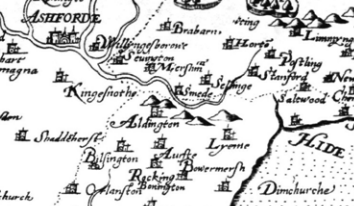
My previous post talked about William Blechynden, his family, his children and the new information gleaned from a new family tree and his will. This one will touch on the property outlined in his will and who he leaves it to. Where I can add a little colour about where that land is and other parties mentioned in the will – the 15th century names of places have stumped me in quite a few cases – or who he bought it from I have done so. I have also retained the spellings used in the will in most places and added the modern version of them and/or used an alternative spelling for example as in the probate records.
Generally speaking, William leaves his property to his wife Margaret (nee Fox) on the basis that she does not remarry for 12 years and ensures the education of his four youngest sons and provides a dowry for the marriage of his daughters. I have written a little more about Margaret in my post here: William Blechynden of Mersham, d 1510
James, the eldest son receives some property immediately upon the death of William which suggests he is already of age when William writes his will and John, the second son, receives some property after the 12 years so perhaps he is 21 by then (giving an approximate birth date of 1502) but even after the 12 year period some of William’s lands remain in trust until Humphrey, Edward and Christopher reach the age of 21 indicating that they are the younger sons.
SO Who gets what?
In summary:
John – gets “various lands in Mersham and Brabourne” which once belonged to William Fox. In the absence of John having any heirs they are to pass to Humphrey then Edward then Christopher. There is no mention of James here which makes me conclude that these boys are the sons of Margaret and not of Agnes. I have written about John here: Tudor Crispes, Crayfords and Blechendens.
John – after the death of Margaret, John receives a mill at Sandherst with an adjoining piece of land called Hoggyhin of and in all his lands called Heldislands, IIII (4?) acres of meadow called Long Sand herstmed, IIII acres of meadow called Pykmed (Pike Meadow) in Wye which is “holden by copy of the Abbott of Batell” (the Benedictine Abbey of St. Martin at Battle in Sussex once held lands in Sussex, Berkshire, Essex, Surrey and in Kent), one acre called Tenyght Acre, three acres of meadow called Heald_____; an acre and a rod called Goldmede; and three acres and a half in Bredemede.
Humphrey – after the 12 year period, Humphrey receives the issue and profits of the lands and rents that William recently purchased of Simon Manyng (Manning) and from a piece of land purchased of “Kynett” next “Gentillis” lying and being in Aldington unto Humphrey is 21 and then William’s feoffees are to deliver the land as a lawfull estate to Humphrey and his heirs and assigns forever. Kynett may be William Kynett of Smeeth – his will was in probate in 1492. I have not identified who Gentillis is. Simon Manning of Mersham’s will was in probate in 1510.
Edward – after the 12 year period Edward receives the issue and profits of the land and tenements known as “Jenkins” in Mersham and which William purchased from the feoffees of John Jenkin. When Edward reaches the age of 21 the land is to be transferred to Edward and his heirs. John Jenkyn of Mersham died in c1480 and although it is unclear when the land was sold to William it would seem there was some unhappiness about this as, in 1501, John Jenkyn’s grandson, Simon Chetynden, brought a case against William Blechynden, Simon Manning and others about a “messuage and lands in Mersham, Brabourne, and Smethe” (see records at the National Archives, Kew).
Edward – immediately after the death of Margaret, Edward is to receive a messuage and land called Hobbs with 15 acres of land in Wye and Mersham.
Christopher – gets an annuity of six shillings and eight pence yearly from lands called Crawlands in Romney Marsh that William purchased from William Bernys. (The Canterbury Probate Records Database records a William Bernys of Wye who died in 1479.) He also gets part of lands called the Barre in Rokynge (Ruckinge) that William and Henry Eshurst (Ashurst) of Kingsnorth purchased from Alice Goddard, widow of the parish of Bilsington. William adds a condition which allows Henry Eshurst to buy out Christopher’s part of the Barre provided that he he delivers part of his own estate “in lyke condicion” to Christopher.
Christopher – also is to receive, following the decease of Margaret, the “principall mesuage and lands called Blechynden lyng in the pishe of Bethersden”. The way the will is set out leads me to conclude that Chrisopher is the youngest son so it is surprising that he gets the principal dwelling house carrying the family name. I wonder if this was a more modest family property before Quarrington Manor and then the move to Aldington.
James – following the decease of his father gets 10 acres of land recently purchased off William Ledmer in Aldington. Also, 15 acres of marsh lands in Estbregge (Eastbridge) so that James will pay £10 to his sister Johane’s marriage. These marsh lands William redeemed out of “Armond Bergh” which I think this is a poor transcription for Arnold Barowe. Evidence for this land transaction can be found at the National Archives and Canterbury Cathedral Archives and Library. Note that a “moiety” does not mean that William and John received the 40 acres, it means he received a portion of the land and it would seem that portion was 15 acres worth. See below:
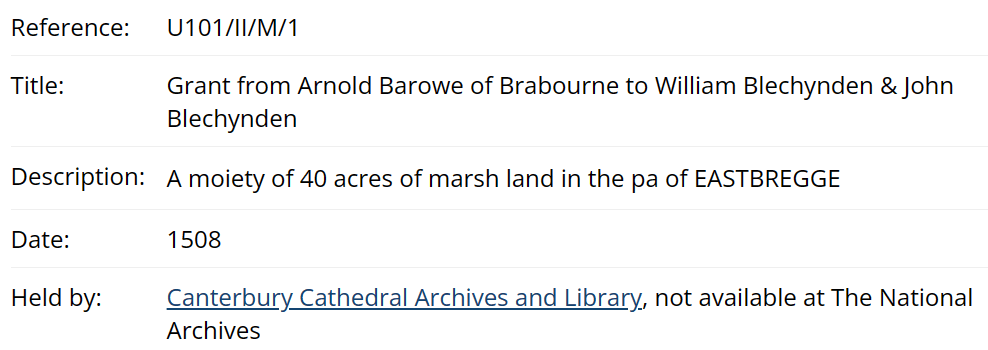
I wonder if John here is perhaps a brother of William, rather than his second son, given that son John would have been no more than an infant in 1508?
Canterbury Probate Records database show that Arnold A’Barow of Brabourne died around the same time as William making his will in 1510 with probate in 1511. Arnold and William had had a long acquintance: this record below from 1480-1483 held by the National Archives shows “William Blechynden of London, gentleman” and “Arnold Berough of London, Yeoman” involved somehow in a case which involved Horton Priory not far from Mersham. Although this is not about William’s property (excuse the deviation) it’s interesting because it suggests that perhaps as young men William and Arnold spent time living in the capital and not just in rural Kent.

James – after the death of Margaret, James also gets a piece of meadow next to Evegate Mill. After the 12 year period James is also to receive an estate comprised of three pieces of land: one called Goldhill, the second Wallistrost and the third a “yarle conteyning VII acres and a half of land”.
Conclusion
What has surprised me most about William’s will is what it shows about the extent to which William went to ensure his sons all had land and properties left to them, even though most of them would have been infants when he died. William was not nobility but he is a “gentleman” and given how active he was in the land market in East Kent he must have had money, influence and contacts to enable him to do this.
What is disappointing about the will is that there is no specific mention of those properties which pepper other wills and records, specifically Quarrington Manor in Mersham and the two properties in Aldington which came to William following his marriage to Agnes Godfrey, namely Ruffins Hill and Simnells. This leaves a small, but nagging doubt, that this William is the William who marries Agnes Godfrey although it is possible that separate arrangements were made for those properties in the event of Agnes’ death. What we do know for certain are the names of his sons and daughters and that he left, to his sons at least, land and properties in Brabourne, Smeeth, Mersham, Wye, Aldington, Bethersden, Romney Marsh and Ruckinge amongst other lands that I can’t quite place.
 My Family History Notes