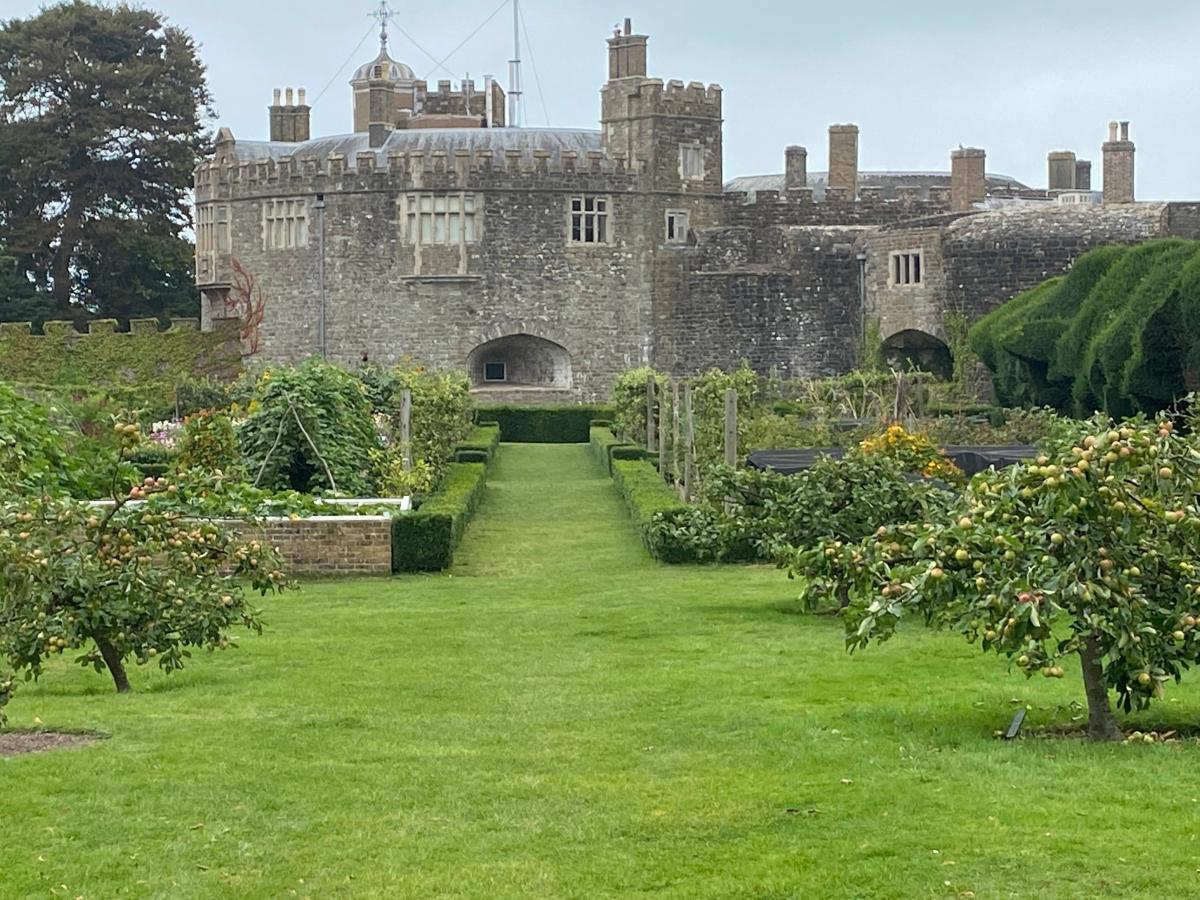
This post is about William Blechenden, the son of James Blechenden of Aldington and grandson of William Blechenden of Mersham and Agnes Godfrey. William was the second appointed Captain of Walmer Castle whose specific role was to command a small garrison on the south coast of England to help prevent any foreign invasion but who sadly was murdered, not by foreign troops, but by “a felon” in the Castle in 1557.

Walmer Castle was built in 1539/40 at the instruction of King Henry VIII in response to concerns about invasion from Europe following Henry’s divorce from Katherine of Aragon, the creation of the Church of England and the seizing of church lands and property. Walmer, along with Deal, Sandown and other reinforcements were built to resist invasion through the use of big guns to sink any enemy ships and troops to fight any landing force. This threat never really materialised although it came close with the Spanish Armada in 1588. Walmer Castle became, over time, the official home of the Lords Warden of the Cinque Ports. What is now a ceremonial position was once named Keeper of the Coast, and has been held by the Duke of Wellington, William Pitt, Sir Winston Churchill, WH Smith (the bookseller and politican) and Queen Elizabeth the Queen Mother.
William must have been only a young man when he was appointed to the position of Captain. The History of Walmer and Walmer Castle by Charles Robert Stebbing Elvin, published 1894, provides a list of the Captains of Walmer Castle and it states that William Blechenden was appointed the 12 June 1551. However, Privy Council records indicate that he was Captain from a much earlier date and, if not the first Captain of the Castle, then probably appointed shortly after the Castle was built.
To be specific, in the records of the Privy Council dated 18 November 1545, which was held at Oatlands Palace, there is a reference to a disagreement between William Blechenden and his deputy John Barley and two of his gunners John Barrow and Henry Gryffin (D.N. Oatlands was a Royal Palace in Surrey and is also where Henry VIII married Katherine Howard in 1542). Although it is unclear what happens to John Barley the two gunners are dismissed from Walmer because of their “lewde demeanour towards their Capitayne” and sent to serve in France. See the extracts below and at British History Online https://www.british-history.ac.uk/acts-privy-council/vol1/pp251-275:
Acts of the Privy Council 1545: John Barley, Deputie of Walmer Castle in the Downes, complayning to be interrupted by William Blechenden, his Capitayne, both for his office, wages, and license of absence specially granted by the Kinges Majeste, and lykewise John Barrowe and Henry Griffyn, gonners, complayning to be thrust out, had letters to the sayd Blechenden for their contynuance, thone bicause his Majeste reserved to himself thappointement of the Deputiship, and thother for that they had billes signed for terme of lief, and if he had juste matier, to charge them by advertisment hither.
And:
Acts of the Privy Council 1546: John Barroe and Henry Griffyne, late gonners at Walmer Castle, and dismissed thens for their lewde demeanour towardes their Capitayne, were addressed with letters to therle of Hertford, Lieutenant of the Kinges Majestes Armye, to be placed there by his discrecion, and for their conduite and cotes had by warrant to Treasourour of the Chambre xxxviij’.

William was the son of James Blechenden and “…Finch”. I have not been able to establish who “Finch” is although there is a prominent family of that name in Eastwell which is only two miles from Kennington in Kent, where John, William’s son, and also Thomas, his grandson, spend some of their youth. It seems likely that there is a family connection here but as of yet this is unproven.
If William was Captain of Walmer Castle from at least 1545, and not 1551, then he must have married whilst he was Captain. His wife is Millicent See, one of the three daughters of Henry See of Herne and the Monumental Inscription below suggest she was born in c 1538. See, or Sea, is also spelled Atsea and Atte Sea and some records (perhaps just a mistransciption) use Gee and even Lee. Note the following Monumental Inscription in St Nicholas Church, Thanington, to Millicent, William’s wife, as recorded by Rev Bryan Faussett in 1757:
Here lies Buried Millicent, One of ye Daughters, Coheirs of Henry GEE, Gentleman; First, Wife of William BLECHENDEN of Aldington Esq. Wife, Next, to Hieram BRETT, of Leeds Esquier. Lastly, Wife to Thomas BROWNING Gentleman. Aged 74 Years. Died Widow. 24 Octob. 1612.
Additional evidence of William’s marriage to Millicent See is provided by the following Court Case involving William Blechenden (Blackenden) shortly before he died with Millicent his wife, his two sisters in law and their husbands: Mary See who married Edward Crayford and Elizabeth See who married Arthur Chowte. The court case is about various property including the manor of Makinbrooke (Mekynbroke) which was held by Henry See (Lee) esq. deceased. Phillip Chowte, the defendent, was the husband of Elizabeth Girling (who first married Richard Crompton, Mercer of London, then Henry See, then Philip Chowte).
Short title: Blackenden v Chowte
Plaintiffs: William BLACKENDEN, Millicent his wife, Edward CRAYFORD, Mary his wife, Arthur CHOWTE and Elizabeth his wife Defendants: Phillip CHOWTE, esquire Subject: Detention of deeds relating to the manor of Thornton alias Bartletts (in St Nicholas at Wade), Northolme, North Ryckett, and Madford (in Hemyock), and a messuage and lands in the manor of Mekynbroke (in Chislett, Herne and Hoath) and Madford, late of Henry Lee, esquire, deceased, father of the female complainant. Kent, Somerset, Devon.
When Henry See died (will dated 1537) he left one male heir but he must have died shortly afterwards as Henry’s daughters, including Millicent became coheirs. Given that Millicent See was born c 1538 and Henry See’s will was dated 1537 it is likely tht Millicent was either born after her father died or shortly before he died. Henry See was a barrister at Lincolns Inn and also the Member of Parliament for Bramber in 1529. Information on Henry See is available at http://www.historyofparliamentonline.org

The 1574 Visitation of Kent helpfully sets out a family tree from William Blechinden of Mersham and this shows that Captain William Blechenden and Millicent See had at least two children before his untimely death: John and Anne and I will devote a couple of posts to John. I have been unable to find any further record of Anne.
We know that Millicent See was born in c 1538 but was a widow with two children by 1557/8. We also know that her son John was an infant when his father died and given Millicent’s age this would suggest that William and Millicent were married no later than 1555 by which time Millicent was just 17. I have also tried to establish William’s likely age; if we assume he was at least 20 years old when he was Captain of the Castle – and the privvy Council records suggest he was Captain in 1545 – then he would be born no later than 1525 which in turn would mean his father James married the daughter of “Finch” and had William by the age of 18 (if James is born c1507 which needs verifying). This all feels quite “tight” in terms of the dates and ages but not impossible. The inconsistency in dates of appointment between the Acts of the Privvy Council and those in The History of Walmer and Walmer Castle is also a cause for some concern but one which given the passage of time may never be resolvable.
What we do know, however, is that William was, whilst on duty probably late in 1557, murdered “by a felon” who had got into the Castle. We don’t know the name of the felon – perhaps it was one of the disgruntled gunners that were sent to France! – but we do know he was captured and held in Canterbury gaol but after some demands from the people of Sandwich he was tried and then executed there in 1558 (see The History of Walmer and Walmer Castle by Charles Robert Stebbing Elvin, 1894 and Collections for an History of Sandwich by William Boys, 1792). William left behind, a young widow Millicent and their two infant children.
update(7 Jan 2022)
Since writing the above I have uncovered some additional, rather grisly, details of William’s murder. In 1682 (printed 1689) Jos. Keble Esq of Grays Inn wrote a book pulling together the “particular clauses of all such statutes from Magna Carta to James II that do any ways concern the power of Justices“. This is intended to be a useful reference book of legal precedent for Justices of the Peace and covers statues across a diverse range of issues such as “bastardy and bawdery”, “popery”, “conjuration”, as well as serious crimes such as treason and murder.
There are some specific examples of how statutes have been applied and one of these refers to the murder of William Blechenden. The example given relates to whether someone should be judged as guilty of an offence if they assisted it to happen but did not take part in the actual crime. Sir William Portman (d. 1557), Chief Justice to the Kings Bench, ruled that they were as guilty and this principle was also applied in the murder of William Blechenden. Here, although murdered by a stranger, Keble’s book states that this was “by assent” of some of Blechenden’s servants. It isn’t clear to me whether the servants actually aided the murder eg by letting the murderer into the Castle even though they are described as being in the Vault of the Castle and not in the “Parlor where he was kill’d”. The legal precedent established by Portman would suggest to me that they did aid the murderer or as a minimum knew it was happening but did nothing to come to their Captain’s aid.
There is a reference at the end of the example to someone being “Drawn and Hang’d” and initially I read this to mean that William was murdered in that way but on reflection this seems unlikely especially if he was killed in the “Parlor”. I think Keble is instead recording the verdict that was meted out to Blechenden’s servants. There is only one other reference in Keble to being “Drawn” which makes clear that this was being tied to the tail of a cart and drawn to another location whilst being whipped along the way. Being drawn and hanged and sometimes quartered was the most extreme of punishments and reflected the seriousness of the crime. To murder the monarch’s appointed Captain in his Castle may have been viewed as an attack on the monarch’s authority or by proxy as if it were an attack on the monarch in person. So a grisly end not only I presume for the murderer, but also to those who assented to it.
But the Law is with Portman, and so it was adjudged in the Case of one Blechenden, Captain of the Castle of Wallm’ in Kent, who about 5 Mariae was kill’d in the Castle by a stranger, by assent of one Bigg and others, Servants of the said B. being then in the same Castle in a Vault there, and not in the Parlor where he was kill’d, and was Drawn and Hang’d.
An assistance to justices of the peace, for the easier performance of their duty.: By Jos. Keble , of Grays Inn, Esq.

 My Family History Notes